|
The Hostages and The Casualties
Sixty-six Americans were taken captive when Iranian militants seized the U.S. Embassy in Tehran on Nov. 4, 1979, including
three who were at the Iranian Foreign Ministry. Six more Americans escaped. Of the 66 who were taken hostage, 13 were released
on Nov. 19 and 20, 1979; one was released on July 11, 1980, and the remaining 52 were released on Jan. 20, 1981. Ages in this
list are at the time of release.
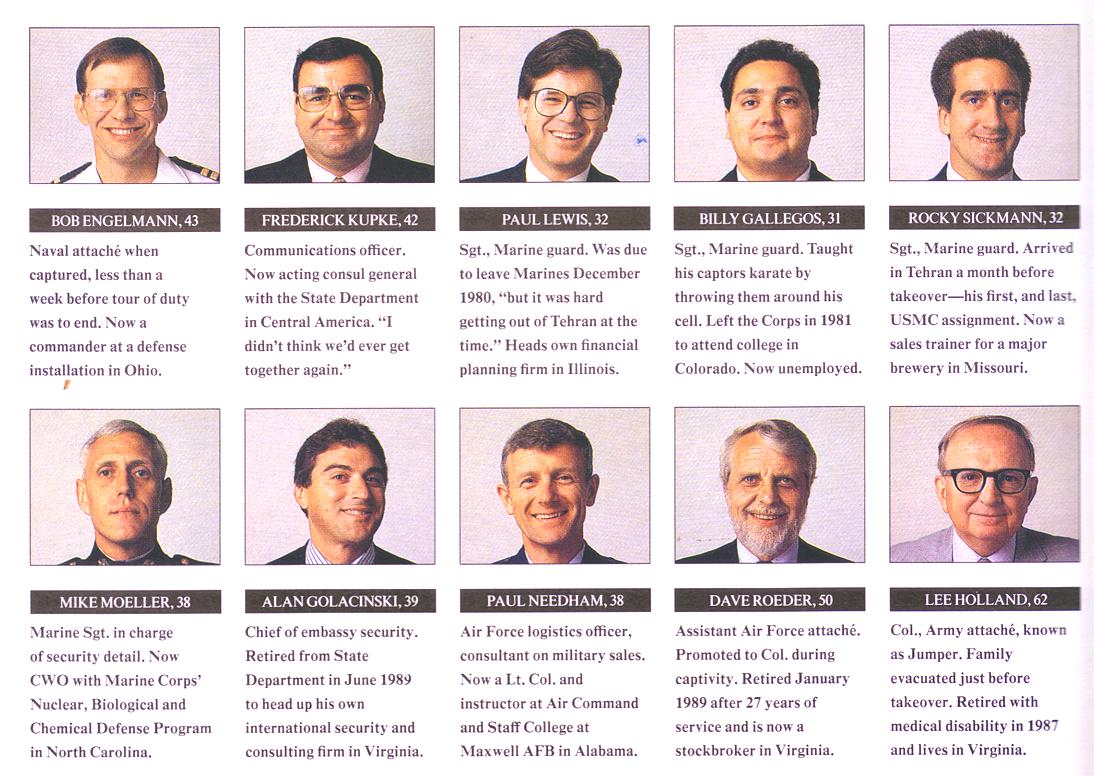
The 52:
Thomas L. Ahern, Jr., 48, McLean, VA. Narcotics control officer.
Clair Cortland Barnes, 35, Falls Church, VA. Communications
specialist.
William E. Belk, 44, West Columbia, SC. Communications and records officer.
Robert O. Blucker, 54, North
Little Rock, AR. Economics officer specializing in oil.
Donald J. Cooke, 26, Memphis, TN. Vice consul.
William J. Daugherty,
33, Tulsa, OK. Third secretary of U.S. mission.
Lt. Cmdr. Robert Englemann, 34, Hurst, TX. Naval attaché.
Sgt. William
Gallegos, 22, Pueblo, CO. Marine guard.
Bruce W. German, 44, Rockville, MD. Budget officer.
Duane L. Gillette, 24, Columbia,
PA. Navy communications and intelligence specialist.
Alan B. Golancinksi, 30, Silver Spring, MD. Security officer.
John
E. Graves, 53, Reston, VA. Public affairs officer.
Joseph M. Hall, 32, Elyria, OH. Military attaché with warrant officer
rank.
Sgt. Kevin J. Hermening, 21, Oak Creek, WI. Marine guard.
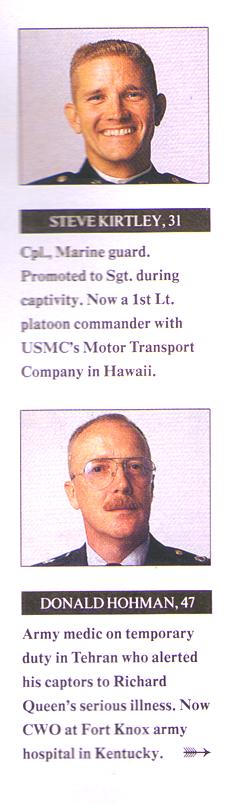
Sgt. 1st Class Donald R. Hohman, 38, Frankfurt, West
Germany. Army medic.
Col. Leland J. Holland, 53, Laurel, MD. Military attaché.
Michael Howland, 34, Alexandria, VA.
Security aide, one of three held in Iranian Foreign Ministry.
Charles A. Jones, Jr., 40, Communications specialist and
teletype operator. Only African-American hostage not released in
November
1979.
Malcolm Kalp, 42, Fairfax, VA. Position unknown.
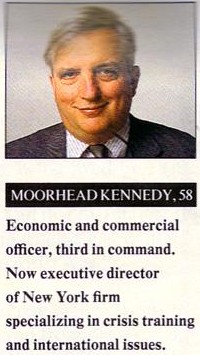
Moorhead C. Kennedy Jr., 50, Washington, DC. Economic and commercial
officer.
William F. Keough, Jr., 50, Brookline, MA. Superintendent of American School in Islamabad, Pakistan, visiting
Tehran at time of embassy
seizure.
Cpl. Steven W. Kirtley, 22, Little
Rock, AR. Marine guard.
Kathryn L. Koob, 42, Fairfax, VA. Embassy cultural officer; one of two women hostages.
Frederick
Lee Kupke, 34, Francesville, IN. Communications officer and electronics specialist.
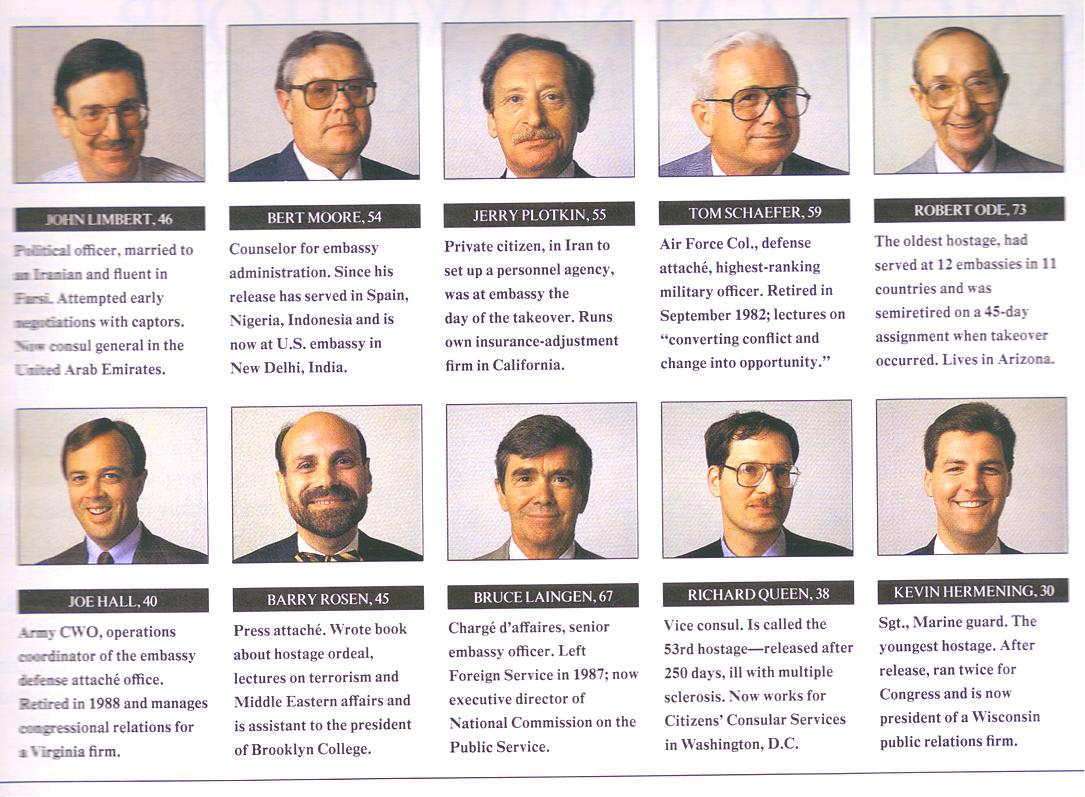
L. Bruce Laingen, 58, Bethesda, MD.
Chargé d'affaires. One of three held in Iranian Foreign Ministry.
Steven Lauterbach, 29, North Dayton, OH. Administrative
officer.
Gary E. Lee, 37, Falls Church, VA. Administrative officer.
Sgt. Paul Edward Lewis, 23, Homer, IL. Marine guard.
John
W. Limbert, Jr., 37, Washington, DC. Political officer.
Sgt. James M. Lopez, 22, Globe, AZ. Marine guard.
Sgt. John
D. McKeel, Jr., 27, Balch Springs, TX. Marine guard.
Michael J. Metrinko, 34, Olyphant, PA. Political officer.
Jerry
J. Miele, 42, Mt. Pleasant, PA. Communications officer.
Staff Sgt. Michael E. Moeller, 31, Quantico, VA. Head of Marine
guard unit.
Bert C. Moore, 45, Mount Vernon, OH. Counselor for administration.
Richard H. Morefield, 51, San Diego,
CA. U.S. Consul General in Tehran.
Capt. Paul M. Needham, Jr., 30, Bellevue, NE. Air Force logistics staff officer.
Robert
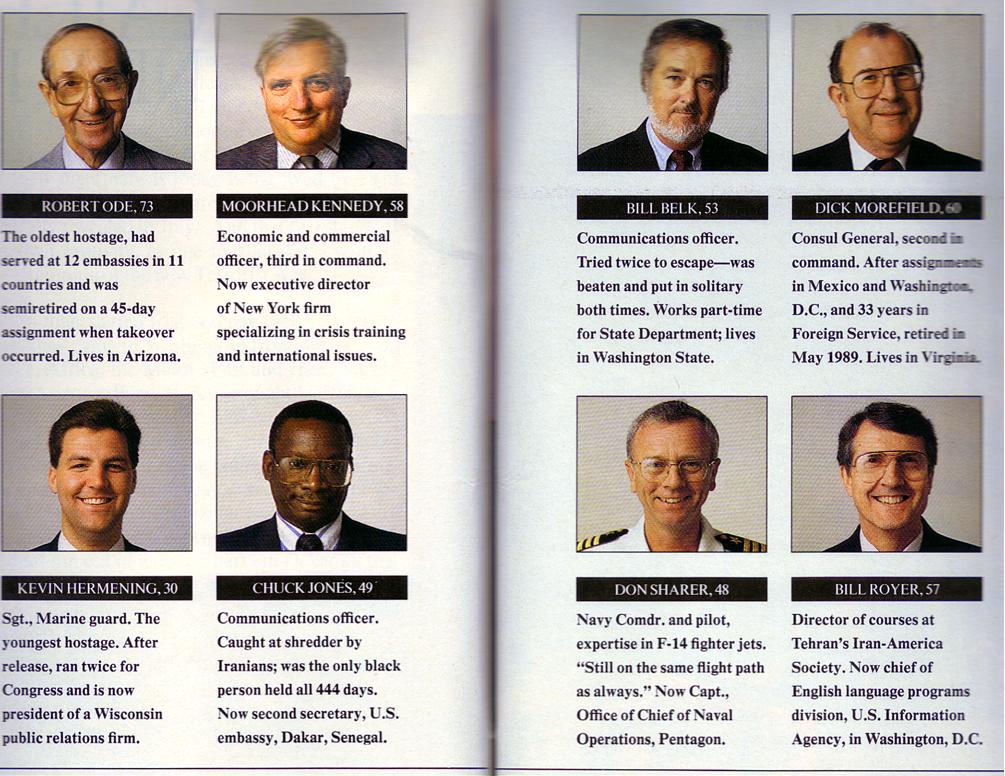
C. Ode, 65, Sun City, AZ. Retired Foreign Service officer on temporary duty in Tehran.
Sgt. Gregory A. Persinger, 23, Seaford,
DE. Marine guard.
Jerry Plotkin, 45, Sherman Oaks, CA. Private businessman visiting Tehran.
MSgt. Regis Ragan, 38, Johnstown,
PA. Army noncom, assigned to defense attaché's officer.
Lt. Col. David M. Roeder, 41, Alexandria, VA. Deputy Air Force
attaché.
Barry M. Rosen, 36, Brooklyn, NY. Press attaché.
William B. Royer, Jr., 49, Houston, TX. Assistant director
of Iran-American Society.
Col. Thomas E. Schaefer, 50, Tacoma, WA. Air Force attaché.
Col. Charles W. Scott, 48, Stone
Mountain, GA. Army officer, military attaché.
Cmdr. Donald A. Sharer, 40, Chesapeake, VA. Naval air attaché.
Sgt. Rodney
V. (Rocky) Sickmann, 22, Krakow, MO. Marine Guard.
Staff Sgt. Joseph Subic, Jr., 23, Redford Township, MI. Military policeman
(Army) on defense attaché's staff.
Elizabeth Ann Swift, 40, Washington, DC. Chief of embassy's political section; one of
two women hostages.
Victor L. Tomseth, 39, Springfield, OR. Senior political officer; one of three held in Iranian Foreign
Ministry.
Phillip R. Ward, 40, Culpeper, VA. Administrative officer.
One hostage was freed July 11, 1980, because of an illness later diagnosed as multiple sclerosis:
Richard I. Queen, 28, New York, NY. Vice consul.
Six American diplomats avoided capture when the embassy was seized. For three months they were sheltered at
the Canadian and Swedish embassies in Tehran. On Jan. 28, 1980, they fled Iran using Canadian passports:
Robert Anders, 34, Port Charlotte, FL. Consular officer.
Mark J. Lijek, 29, Falls Church, VA. Consular officer.
Cora
A. Lijek, 25, Falls Church, VA. Consular assistant.
Henry L. Schatz, 31, Coeur d'Alene, ID. Agriculture attaché.
Joseph
D. Stafford, 29, Crossville, TN. Consular officer.
Kathleen F. Stafford, 28, Crossville, TN. Consular assistant.
Thirteen women and African-Americans among the Americans who were seized at the embassy were released on Nov.
19 and 20, 1979:
Kathy Gross, 22, Cambridge Springs, PA. Secretary.
Sgt. James Hughes, 30, Langley Air Force Base, VA. Air Force administrative
manager.
Lillian Johnson, 32, Elmont, NY. Secretary.
Sgt. Ladell Maples, 23, Earle, AR. Marine guard.
Elizabeth Montagne,
42, Calumet City, IL. Secretary.
Sgt. William Quarles, 23, Washington, DC. Marine guard.
Lloyd Rollins, 40, Alexandria,
VA. Administrative officer.
Capt. Neal (Terry) Robinson, 30, Houston, TX. Administrative officer.
Terri Tedford, 24,
South San Francisco, CA. Secretary.
Sgt. Joseph Vincent, 42, New Orleans, LA. Air Force administrative manager.
Sgt.
David Walker, 25, Hampton, TX. Marine guard.
Joan Walsh, 33, Ogden, UT. Secretary.
Cpl. Wesley Williams, 24, Albany,
NY. Marine guard.
Eight U.S. servicemen from the all-volunteer Joint Special Operations Group were killed in the Great Salt Desert
near Tabas, Iran, on April 25, 1980, in the aborted attempt to rescue the American hostages:
Capt. Richard L. Bakke, 34, Long Beach, CA. Air Force.
Sgt. John D. Harvey, 21, Roanoke, VA. Marine Corps.
Cpl.
George N. Holmes, Jr., 22, Pine Bluff, AR. Marine Corps.
Staff Sgt. Dewey L. Johnson, 32, Jacksonville, NC. Marine Corps.
Capt.
Harold L. Lewis, 35, Mansfield, CT. Air Force.
Tech. Sgt. Joel C. Mayo, 34, Bonifay, FL. Air Force.
Capt. Lynn D. McIntosh,
33, Valdosta, GA. Air Force.
Capt. Charles T. McMillan II, 28, Corrytown, TN. Air Force.
This list was adapted from information in Free At Last by Doyle McManus.

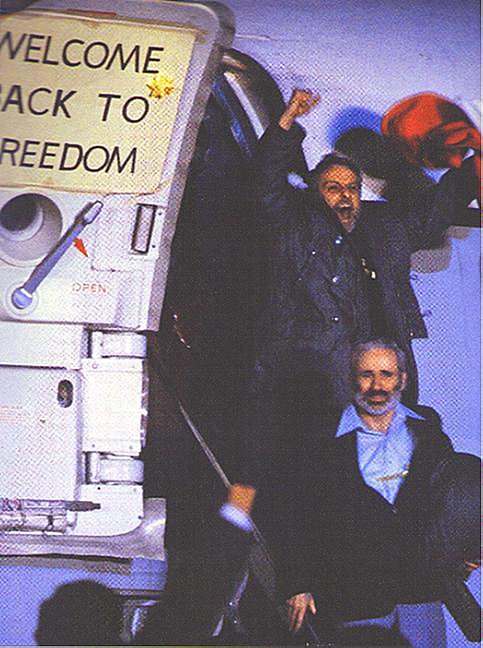
The Hostages Finally Arrive Home in the United States!
The following is an excerpt from the Tuscon Weekly
"Hostages
Reveal Iran Torture.
"The emancipated hostages told of beatings and other atrocities at the hands of the Iranian
captors today as they telephoned their loved ones back home.
"One said ... he was told by Iranian interrogators
... that his mother had died. He didn't learn that she was still alive until the freed captives reached Germany this morning.
"As they began a stay of several days at a U.S. military hospital in Wiesbaden, Germany, most of the 52 hostages
talked with their families for the first time in 445 days. ...
"Col. Leland Holland, 53, security chief of
the U.S. Embassy in Tehran ... 'spent a month in what he called the
"dungeon" and said his captors were S.O.B.s,'
said the colonel's mother. 'He said his house was ransacked and
everything taken, including his watch and rings. They
took all the furniture and clothes.'
"A spokesman for the family (of Duane 'Sam' Gillette) said: 'His treatment
was at times disgusting. I think President
Reagan was polite when he termed the Iranians barbarians. We know that his
letters were covering up what the real
situation was. There was no physical torture, but there was psychological pressure.
The food wasn't good and the
conditions were very poor.'
"And the family of Malcolm Kalp said ... 'He
told us he was beaten by them and placed in solitary confinement because of his escape attempts.' He served from 150 to 170
days in solitary. ...
"Returnee David Roeder, 40, of Washington, D.C., said, 'I've never been so proud to
be an American in all my life.' ...
"Outside the hospital ... the crowd ... broke into a chant of 'U.S.A., U.S.A.'
Only 12 hours and nine minutes earlier, the two women and 50 men hostages flew out of Iran on an Algerian jet to the Islamic
Revolutionary Guards' jeers of 'Down with America' and 'Down with Reagan.' ... "


Click here to go to the original web site of this next article
Iowan drew on faith during hostage ordeal
Posted March 13, 1999
By James Q. Lynch
Gazette
Northeast Iowa Bureau
WAVERLY -- The 444 days she spent as a hostage in Iran may define Kathryn Koob in the eyes
of others, but she doesn't think of the ordeal often.
"I think about it when I'm asked," she said at
a press conference Friday at Wartburg College. "It's a part of my life."
She has been able to move on
from the hostage experience that began almost 20 years ago because her faith allowed her to cope with the situation at the
time, Koob said. Isolated from the 50 other hostages, she drew on the faith she learned growing up in an "orthodox Lutheran"
household in Eastern Iowa.
"Without that faith, I don't know what I would have done," Koob said. "It
never occurred to me not to use that faith, the strength that I had been told would be there when I needed it."
She accepted her captivity as a challenge, "something I could not change, but had to learn to live with."
"I didn't like it, but told myself that with the help of God I'll get past it," she said.
As
a result, Koob said, she was able to leave her anger behind in Iran along with her ice skates and some of her favorite recordings.
In spite of her experience there, Koob is encouraged by diplomatic efforts to re-establish links between Iran and
the West.
Apart from a visit to the United Nations last year, Iranian President Mohammad Khatami's visit to Italy
this week was the first an Iranian leader has made to a Western nation since the 1979 Islamic revolution installed the rule
of the clergy in the country.
Student leaders of that revolution took control of the U.S. Embassy in Tehran in
November 1979 and held Koob and her colleagues hostage.
"I had hoped we could recognize our differences even
sooner," she said about the diplomatic efforts. "But perhaps slower is better.
"However angry we
might be about the hostage crisis, Iran is a country full of wonderful people, intellect and culture, and should be a part
of the world community," Koob added.
Terrorists still take hostages, but Koob came to Wartburg in Waverly,
where she now lives, to talk about other forms of terrorism. She spoke at her alma mater on "Terrorism: Antecedents
and Present Action."
"What we're looking at now is narco-terrorism, bio-terrorism, cyber-terrorism and
nuclear terrorism," she said. "In these cases, the threat is the terror.
"There is much more reason
to be worried about bio-terrorism than even a small group of terrorists with a bomb," she said. "The threat is
much, much larger."
She called on federal, state and local governments to prepare responses to these new forms
of terrorism. The same resources and effort applied to studying nuclear war scenarios must be applied to preparing to respond
to the new threats of terrorism, she said.
Click here for the original web site of the next article

The Daily Princetonian
Monday, October 18, 1999
Founded 1879 - Online since 1997 Kennedy '52 relates details
of months as hostage in Iran
By KATY ZANDY
Imagine spending 444 days wondering every waking moment whether
or not you would live another hour. For Moorhead Kennedy '52, this nightmarish scenario became a reality in 1979.
Kennedy spoke last night about his experience as a U.S. embassy employee during the Iran hostage crisis as a part of the
'02-'52 lecture series.
In the speech, he described the final days before a group of young Iranians stormed the
embassy compound in Tehran, his days of captivity and a few of his thoughts in hindsight.
Kennedy was introduced
to an audience of about 90 in the Rockefeller College common room by his classmate, Hal Saunders '52, who was assistant secretary
of state at the time of the crisis. Kennedy's wife, Louisa Kennedy, also added her perspective on the experience.
Cut off Saunders described hearing the final words in Washington from embassy officials before contact was cut off – "we're
going down now" – and defended the decision to not pull personnel out of Iran before the crisis.
Following
him, Kennedy said, "The decisions that Hal and his superiors made were not all perfect, but they worked, and the proof
is that you now have a speaker."
Kennedy related the apprehension that he felt in the days before the crisis,
as the embassy began to realize that a serious conflict was almost upon them.
In particular, Kennedy recalled
the prediction he heard just before the crisis from a Marine guard at the embassy. "Man, we're going to have an Alamo,"
the soldier said.
Kennedy went on to describe the denial that he experienced during the early stages of being a
hostage. He slept in one bed with two other men, wearing his suit jacket and tie because he believed that he would be released
any minute.
His wife echoed his initial feeling of denial. "In any crisis, you're going to find a moment
where you accept it. If you're wise, you find ways to normalize it. This took time for the families to get used to,"
she said.
In reaction to the crisis, she volunteered for the State Department and formed the Family Liaison Action
Group, which raised money for medical and psychiatric help for the families of the hostages.
After Kennedy spoke
about her experience during the crisis, her husband finished the story of his captivity – replete with its moments of terror.
"When you are overcome with fear, your legs begin to twitch," he said. "You live on every thread
of evidence, often wrong, and often reaching the worst conclusion."
At the beginning of his captivity, Kennedy
said he was held in the American embassy in Tehran. However, after President Jimmy Carter ordered a helicopter rescue that
ended in failure, the hostages were spread out over the country.
There was a long period of waiting after the
rescue attempt where he was moved frequently, but saw little progress toward a resolution. Finally, a guard walked into
Kennedy's room and said, "OK, let's go."
"Our hearts stopped," Kennedy recalled. "We said,
'Go where?' And he said, 'Home.' "

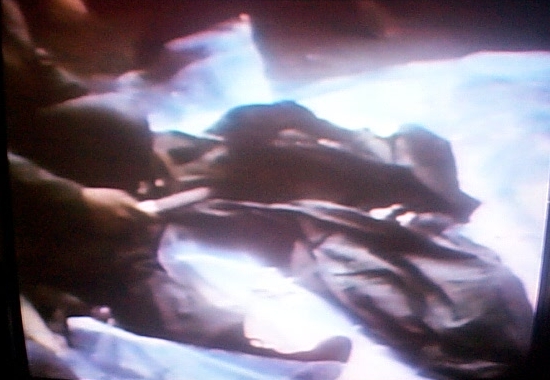
This is a photo of what the Iranians did to the dead Americans who took part in the rescue attempt. This is a
shot of an Iranian man taking his knife to one of the bodies. He eventually took off the head of the dead
American. This is a barbaric act, but it is not as crude as the next photo, taken of someone who is supposed to
represent the religion of Islam.

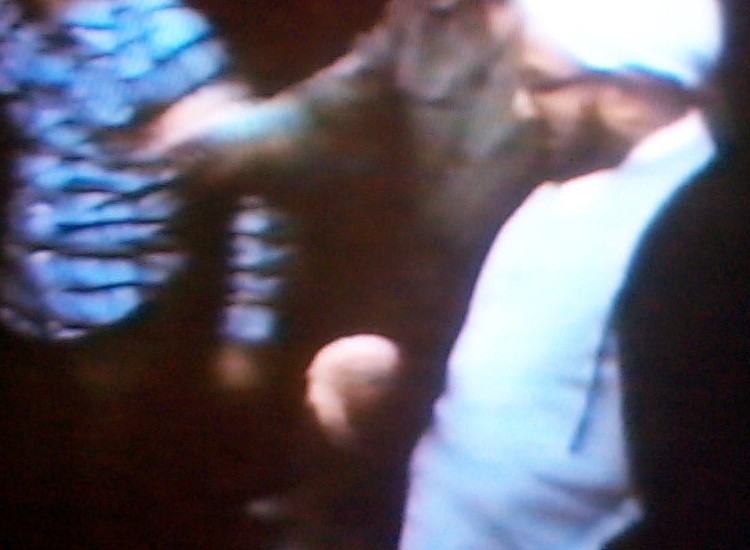
This is a photo of someone who was supposed to be a holy man in Islam. His name is Ayatollah Kalkali. He literally spit on
the bodies of our Marines and Airmen that died in Desert One in the attempt. I consider him a criminal, too.
Click on the link to proceed to the original web site for the next article

CAN IRAN BE FORGIVEN?
A dramatic meeting between a former American hostage and one of his captors could be a powerful
symbol of reconciliation
By SCOTT MACLEOD
It has been almost 19 years, but the images from Tehran are
forever burned into the American psyche. The sudden assault on the U.S. embassy by Iranian students. The angry street mobs
shouting "Death to America!" The parades of helpless, blindfolded hostages. Back home, outraged Americans could
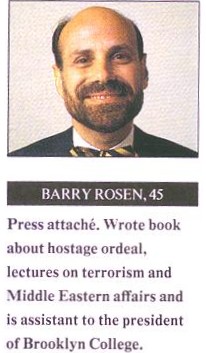
only imagine the horrors that the 52 prisoners faced during their 444 days of captivity. Barry Rosen did not have to imagine.
He was there. As the embassy's press officer in 1979, he was not only taken hostage at gunpoint but also accused of leading
a spy ring and subjected to a mock trial. His punishment included months in a barren prison cell, where an always burning
light bulb and constant stress made it almost impossible for him to sleep.
The American government has never forgiven
Iran for what happened, so why should the hostages? But rather than carry resentment around for the rest of his life, Rosen
has decided to make a remarkable gesture of reconciliation. This Friday at a conference in a U.N. building in Paris, he will
come face to face with Abbas Abdi, one of the dozen student leaders who planned and directed the hostage taking. As the dramatic
meeting unfolds, the former hostage and his former captor will give talks on U.S.-Iranian relations, sit down for meals together
and probably even shake hands. That powerful image of healing is sure to be criticized by hard-liners in Iran and by many
Americans, perhaps including other ex-hostages. Both men are attending as private citizens and do not represent their governments
or any groups.
In interviews conducted by TIME with Rosen in New York City and Abdi in Tehran, they said they were
encouraged to meet after Iranian President Mohammed Khatami's call last January--quickly taken up by President Clinton--for
cultural exchanges aimed at bringing down the "wall of mistrust" between their two nations. The idea for the meeting
originated with Iranian moderates who were friends of Abdi's. They approached a Cyprus-based human-rights group called the
Center for World Dialogue, which organized the conference and invited Rosen. Although the two men are still poles apart in
their thinking, they welcomed the chance to put the past behind them and help their countries build fresh ties. "I am
not naive about Iran, but I think it is important to understand one another's feelings," says Rosen, 54, director of
public affairs for Teachers College, Columbia University, in New York City. "I don't have to forgive and forget. But
we are trying to restart this relationship, and this is an important beginning." Agrees Abdi, 42, a columnist for Salam,
a Tehran newspaper: "The aim is to contribute to a better understanding and promote a normalization of relations."
That is easier said than done.
Plans for a London meeting were aborted when British authorities refused Abdi a visa.
He has had to make his preparations in utmost secrecy lest Iran's still powerful hard-liners detain him before his departure
for France. Once a fervent supporter of Iran's clerical regime, Abdi was arrested in 1993 and spent nearly a year in prison
for criticizing the mullahs' aversion to democracy. Rosen has had to overcome his own concerns. Will a public reconciliation
with Abdi create a backlash in Iran against the rapprochement that Rosen deeply hopes for? Or will Abdi somehow publicly
embarrass him? While Abdi is ready to shake hands, Rosen is reluctant to commit himself until the moment comes. He hopes,
though, that his meeting with Abdi will help "close the circle, close that 444 days." That would bring Rosen closer
to a country he loved--and still loves, despite his hostage ordeal.
He first went to Iran as a Peace Corps volunteer
in 1967 before taking up graduate studies in Iranian culture at Columbia University three years later. He became U.S. embassy
press attache in Tehran in 1978, at the height of the revolution that overthrew the Shah. And he was in the embassy on Nov.
4, 1979, when bearded militants poured over the compound's walls and began the 15-month hostage crisis.
Among those
militants was Abdi. In an interview at his spare Tehran office a few blocks from the old U.S. embassy--now a school for the
Revolutionary Guards--the Iranian provided rare insight into the takeover and his role in it. The students' aim was to force
the U.S. government to extradite the deposed Shah. They genuinely feared, Abdi insists, that the Shah's arrival in New York
City in 1979 for medical treatment was part of a U.S. plot to restore him to power, as was done by a CIA-engineered coup
d'etat in 1953. Abdi denies that Ayatullah Khomeini ordered the embassy seizure or knew about it beforehand. "The way
we saw it, the Imam would either approve of the action afterward or disapprove of it, in which case we would have left the
embassy," says Abdi. At 7 a.m. on takeover day, Abdi held a secret meeting with 130 students he had summoned to a hall
at Tehran Polytechnic University, where he was leader of the Organization of Islamic Students. He described the takeover
plans, gave out assignments and ID badges and told the students to head, one by one, to the embassy, where they would meet
up with recruits from other universities. As hundreds thronged into the compound, Abdi's task was to seize the embassy's
visa offices while others handled the main building and the ambassador's residence. According to Abdi, the restraint shown
by U.S. Marine guards may have averted a bloodbath. Had they shot and killed any of the students, he says, he and other leaders
planned to depart and leave the compound to be engulfed by the mob.
Abdi says he never guarded the hostages and
has no recollection of meeting Rosen personally. The Iranian still justifies taking the prisoners as a defense against a
potential U.S.-backed coup d'etat, holds American support for a despotic ruler partly responsible for provoking the students
and tends to downplay the ill treatment of the hostages. However, Abdi echoes the conciliatory words spoken by President
Khatami. "No one likes hurting others," Abdi says. "The Iranians regret what the hostages and their relatives
endured." He adds that he can understand why Americans felt that hostage taking was wrong.
Rosen flatly rejects
the notion that the students' ends justified the means: "It is very dangerous when you cross that moral line."
But he sympathizes with Iranian complaints about U.S. support of the Shah's repressive regime. "There is a moral and
ethical question that Americans have to face up to," Rosen says. "The Shah served the purpose of stability in the
region. But we should have been much more aware of and sensitive to what was going on inside Iran, whether it was human-rights
violations or lack of political growth." If that sort of exchange is heard this week in Paris, conference director Eric
Rouleau will judge the gathering a success. "We thought this meeting could contribute to a better understanding,"
says Rouleau, who witnessed the hostage crisis firsthand as a correspondent for the French daily Le Monde. "There are
people in both countries who would like to turn a page of history, a page that was very painful." Rosen and Abdi may
already have begun writing the next chapter.
--With reporting
by Henry Schuster/CNN web site address :
http://www.time.com/time/magazine/1998/dom/980803/world.can_iran_be_forgiv10.htm l
Click on the link to the original web site for the next article.

Former U.S. hostage meets his Iranian captor
Men shake hands, look to future
July 31, 1998
Web posted
at: 11:56 p.m. EDT (2356 GMT)
In this story:
No apologies
Protesters disrupt meeting
Related
stories and sites
PARIS (CNN) -- Almost 20 years after an Islamic revolution overthrew the U.S.-backed government
in Iran, a former U.S. Embassy hostage met face-to-face with one of his Iranian captors.
From 1979 to 1981, Barry
Rosen and 51 other U.S. citizens were held captive for 444 days by Iranian militant students upset over the U.S. decision
to allow deposed Iranian leader Shah Mohamed Reza Pahlavi, who had cancer and other ailments, to enter the United States for
medical treatment.
Other embassy occupants captured when the students stormed the building were released not long
after the takeover.
On Friday, Rosen shook hands with Abbas Abdi, who helped organize the embassy seizure. Their
meeting was organized by the Cyprus-based Center for World Dialogue as part of a three-hour meeting on U.S.-Iranian relations.
Rosen, 54, said the decision to meet with his former captor was one of the toughest he ever made.
"But this
platform is not for remembering only my pain or blows to American honor," he said. "Iranians also suffered deeply."
No apologies
Abdi said the students thought the takeover on November 4, 1979, would last no more than
a week. The hostages were freed on January 21, 1981. He called the occupation "the most nonviolent possible measure taken
... in response to what the United States had done."
Abdi, 42, now a senior editor at the previously hard-line
newspaper Salaam, acknowledged that he was among those who planned the event.
"I could be taken hostage
for 444 days," Abdi said. "This I could overlook. "But taking a nation hostage for 25 years," he said,
"needs more apologies."
The hostage crisis was but "a row of bricks in this tall wall (of mistrust),"
Abdi said. He said the wall's foundation was laid in 1953, with the U.S.-backed coup that toppled President
Mohamed Mossaddegh and returned the shah to the Peacock Throne. Rosen disagreed.
"No
matter how they rationalize, however, they must face up to the wrong and admit, if only to themselves,
that it was unjustified," he said.
In the end, no apologies were given, but the men shook hands and agreed
to look toward the future.
"I'm here with Mr. Abdi, because I want to see Americans and Iranians
turn that difficult corner away from mutual demonizing," Rosen said.
"The past cannot be altered,"
said Abdi. "Instead, we must focus on the years ahead and endeavor to build a better future," he said.
Protesters
disrupt meeting
The hostage crisis remains a sensitive issue, even among Iranians. The start of the session
was interrupted by two Iranian exiles who denounced Abdi as a "mass murderer" and a "terrorist." Both
men were forcibly removed from the hall.
Official Iranian attitudes toward the United States have softened somewhat
since the election last year of Iranian President Mohammad Khatami.
Despite opposition from hard-liners in Tehran,
Khatami has called for a "crack in the wall of mistrust" between both countries.
There was no immediate official response from Iran about Friday's meeting. However, the U.S. State
Department called the encounter "a positive development in the people-to- people dialogue that
both nations support."
The Associated Press contributed to this report.

October 26, 2004
Q&A: Kevin Hermening on the Iran Hostage Crisis
Nov. 4 will mark the 25th anniversary of the start of the Iran Hostage Crisis – a day when Iranian
extremists and militants seized the U.S. Embassy in Tehran and captured several dozen U.S.
diplomats, servicemen and civilians and began a 444-day siege that captivated Americans and the world.
During that 444 days, Walter Cronkite closed each of his broadcasts by counting the number of days the Iranians
– led by extremist religious leader Ayatollah Khomeini – held U.S. citizens in violation
of international law. Ted Koppel also began a nightly broadcast, then called “America Held Hostage,” which later
transformed into “Nightline.” Eight U.S. servicemen died in an aborted rescue attempt,
Operation Eagle Claw, that ended unsuccessfully in a fiery crash in the Iranian desert.
The crisis, many believe, paralyzed the administration of President Jimmy Carter and led to his defeat at
the hands of Ronald Reagan in 1980. The hostages were finally released on the day Reagan was inaugurated.
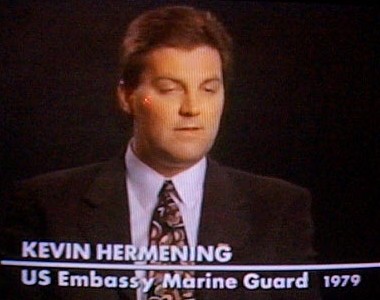
Command Post contributor Ed Moltzen interviewed the youngest of the 52 hostages who had been held for that
period, Kevin Hermening, who at the time was a 20-year old Marine assigned to guard the Tehran embassy. Since 1981, Hermening
has become active civically in Wisconsin, becoming a school board and twice running unsuccessfully for U.S.
Congress as a Republican.
CP: Does it seem like 25 years ago?
Hermening: From my perspective, there is so much that has occurred in my life since then.
It rarely is given a second thought by me. It doesn’t mean that it’s ignored – especially in the context
of current events. Obviously there are a lot of current events that have affected the way that our country has – and
in many aspects hasn’t – dealt with the threat of state-sponsored terrorism.
CP: What are your most vivid memories of your time being held against your will by the
Iranian students?
Hermening: Probably the uncertainty of knowing how it would all end, or if it would come
to an end. There was so much emotion and drama and trauma during that time. Of course, the Soviets had invaded Afghanistan,
the Iraq-Iran war began. There was the failed attempt to rescue us, resulting in the deaths of eight men who perished in the
Iranian desert.
CP: Being a marine, did it make it more difficult for you?
Hermening: There were many aspects of it - including being young - that were involved.
There was an element of adventure and excitement surrounding it. It doesn’t mean we were any less fearful. But when
you’re 20 years old and you’ve been through military training you kind of feel invincible. How quickly that false
image is shattered. Bravado is important, but only if it doesn’t result in your getting yourself foolishly killed. I
tried to escape once – I never really had an opportunity later – that resulted in 43 days in solitary confinement.
CP: Hostage and then-CIA agent William Daugherty wrote a book two years ago in which he describes 444 days of mostly solitary confinement, and suggested he and the other military personnel
taken hostage had it worse out of any Americans. Were you mistreated?
Hermening: After the failed escape attempt by a few of us, about a week later they had
a mock execution that occurred in which they stormed into our rooms in the middle of the night, strip searched us and had
us standing out in the hallway. Some of the most radical elements ran up and down in the hallway – we were spread eagle
– and they were shouting out execution commands at the top of their lungs.
Meanwhile, others were in our rooms searching out for anything we may have had, including weapons. Although
we know now anything can be a weapon.
CP: How did you plan the escape?
Hermening: Joe Subic, Steven Lauterbach and I – in my case, I never made it out of the room. They
had taken us to a different building for showers. They put me into the only room in the ambassador’s residence that
was a safe-room….I never made it out of the room. They immediately handcuffed me and put me into another room, in which
I was put into solitary. Five feet by ten feet.*
CP: Were you able to form a bond, or friendships, with any of the other U.S.
diplomats and civilians that lasts today?
Hermening: Alan Golancinksi was one. Don Cooke and I, we kind of became friends for the
short time we were together. I was roommates with Alan right after I got out of solitary. That was a real relief to me to
get out of solitary confinement. Some of the other guys in Vietnam who were in POW camps for seven
years – my experience pales in comparison. It doesn’t mean it was easy, but I would never try to suggest our (situations)
were similar.
CP: You’ve spoken of your admiration for Ronald Reagan and your opportunities to
meet him. But some hostages, in returning from Iran, have said they were measurably cooler toward President Carter –
whom you also met after you were freed. What’s your assessment of Carter?
Hermening: I would describe it that way, too. But for me, it was in my pre-political days…I
would describe it – there was a cool reception given to him. For me, I would describe it as being honored to meet a
president. I do think that President Carter is one of our best ex-presidents, though I would describe his presidency as a
failed presidency. I fail, personally, to see the merits of putting the interests of 52 individuals ahead of the nation’s
national security. I really do believe our situation was one of the first terrorist acts in a series that have victimized
Americans worldwide. I would further say that when President Carter agreed to return $9 billion of frozen Iranian assets to
the terrorist government under the Ayatollah Khomeini, as Charles Scott said, Iran walked away with no cost in blood or treasure.
In essence, the terrorist organizations, those who put a face on terrorism – al Qaeda, Hamas and others – they
get their support from governments. By not extracting a penalty, or anything punitive, I think it simply encouraged more acts
against Americans.
CP: Looking at Iran today, some of the students who took over the U.S.
embassy are now in positions of power, including Tehran Mary – who is an Iranian vice president – and one
of the leaders who the New York Times has even described as a reformer…
Hermening: I just read recently that some are in the government, some are in the opposition
– today – and some are in prison. That’s, in my opinion, what you get when you look at a group of anarchists
which is really what terrorism is. Anarchy.
CP: Many of the same people who took you hostage are now seeking to expand a nuclear program
for Iran. Is this something that angers you? What are your thoughts?
Hermening: That should scare the heck out of every American and anybody in the West and,
I would submit, their Muslim neighbors. The other thing lost in the broader context is, that Iranians are not Arabs. Except
or Israel and Iran, every other country over there is Arab or Arabic. Iranians are Aryans. Despite their common interest in
a religious background, Islam, they do not share a cultural connection. Hence the acrimonious relationship between Iraq and
Iran and some of their neighbors to the east. I was one of the few people I know, I think, who understood why (Gen. Norman)
Schwarzkopf and Colin Powell decided not to take out Saddam in 1991. We weren’t prepared to deal with, as a country,
militarily or diplomatically, creating a vacuum in Iraq where Syria and Iran could consumer that country. And with all the
difficulty this President Bush has had in winning the peace, at least he is willing to fortify the forces. There are 16,000
forces whose job is to protect the oil fields from sabotage. I personally don’t see that as a bad thing.
CP: Do you believe there are enough pragmatists in Iran to ever see a successful reform
movement?
Hermening: I think there are some forces over there that are interested in breaking the
stronghold the mullahs have on their country. I don’t know. They’ve had, I believe, about two dozen government
buildings burned by government protesters in the last two months.
CP: Anyone under the age of 25 – including what could be millions of voters –
weren’t even born yet when you were held captive. If you could have them understand one thing about that time, what
would it be?
Hermening: I think it would have to include what I consider to be a reality: that there
are individuals and entire governments who are so opposed to Western values and freedom that they are willing to use every
means possible to bring about our destruction. Even to the point they are willing to support financially those who are willing
to come into our own country to make us fearful and uncomfortable without our own borders.
CP: Do people still stop you, and ask questions about your experience?
Hermening: It’s become less and less, just by virtue of the fact that I am more active
in other things. I’ve done a lot of public speaking. I speak on Veterans Days and Memorial Days in schools. I make civic
appearances. The sad irony is that people care more about what we had to eat (while being held hostage) and whether I’ve
had any nightmares since I got back – which I haven’t – than they do wondering how did this happen to begin
with, and how can we protect Americans here and abroad in light of what they’re trying to do today?
CP: Yet at the same time, the same holds true in Iran: Anyone under the age of 25 doesn’t
remember what happened back then – they weren’t yet born. How does this work in our favor?
Hermening: I think that there is some hope, because young people do not have a historical
attachment to the Ayatollah Khomeini…
Once you open up the Freedom Genie, the Technology Genie – whether it’s satellite dishes, or
the Internet, I think it’s next to impossible to put it back. And that’s why I personally hold out a great hope
for many of these Middle Eastern nations to become more democratic. Even for China to try to contain what is likely to spread
like wildefire – and that’s economic development and recognition of personal liberties and civil liberties –
I don’t think you can permanently keep that down.
In Iran, it was a very strong sense that the United States was meddling in the internal affairs of their
country. The mullahs were very fortunate. They almost had the perfect storm: the Shah was getting ill, President Carter being
a particularly weak president not standing by our ally, and we left (the Shah) and all of his supporters out to dry. This
is the big concern that somebody like myself would have in a change of the administration in Washington right now. –
would be people like the president of Pakistan, who has really gone out on a limb at the risk of his own political survival
(although he has the iron hand of military power), Musharraf is using (the military) to support the war on terror. If we have
a total reversal of policy, what’s it going to mean for the folks who have gone out on a limb? Personally, I think it’s
going to mean an even more unstable world over time.
I hate to sound like a partisan – even though I am – but I think in the big scheme of thigns
I think it is more in our nation’s advantage to stand for something principled in a part of the world that only understands
force and, I should say, respects strength.
CP: Is there any one solution for the U.S. to have a normal relationship
with Iran?
Hermening: The problem is we are not in the cold war nay more. Countries such as France
and Germany, and some of the more longstanding alliances, play less of an important role to our national security, and our
way of life for that matter, than they once did. After all, 25 years ago and prior to that, most of our international trade
and international exchange students came from largely western countries. Our economic interaction occurred mostly with Western
nations. That’s because that’s where most of the wealth of the world was located…
Egypt and Pakistan play much more of a role to us today. They are the new France and Germany as an example
- economically, politically, culturally perhaps not yet. I don’t think it’s a bad thing for us to have as an objective
to spread freedom around the world.
Posted By Late Final at October 26, 2004 09:28 PM | TrackBack
Ex-Hostages See Terror Roots in 1979 Iran
A Quarter-Century Later, U.S. Hostages See Beginnings of Modern Terrorism
in 1979 Iran
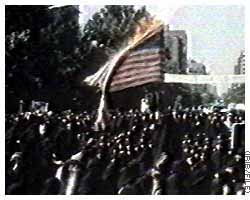
Iranians burn a U.S. flag outside of the former U.S. Embassy in a gathering marking the 25th anniversary of the seizure
of the U.S. Embassy in Tehran, on Wednesday, Nov. 3, 2004.Thousands of Iranian students gathered outside the former American
embassy in Tehran on Wednesday to mark the 25th anniversary of the 1979 storming which led to the year-long "hostage crisis"
between Iran and the United States.(AP Photo/Hasan Sarbakhshian)
McLEAN, Va. Nov 3, 2004 — In the minds of many, terrorists
struck their first blow against the United States on Sept. 11, 2001. But others look back exactly a quarter-century ago, on
Nov. 4, 1979, when 66 Americans were taken hostage at the U.S. Embassy in Iran.
Most remained in captivity for 444 days. Today, reflecting on their experiences
through the prism of 9-11, the war in Iraq and two decades of tumultuous relations with the Middle East, many say the United
States was too late to recognize that a new era had begun.
"The day they took us is the day they should have started the war on terrorism,"
said Rodney "Rocky" Sickmann, 47, of St. Louis County, Mo., an embassy security guard.
Many agree that terrorists were emboldened by their success in the Iran hostage
crisis none of the hostages were killed, but the U.S. government agreed to release $8 billion in frozen Iranian assets and
see the kidnappings and beheadings in Iraq as a consequence.
"Given the terrorist modus operandi nowadays, we probably wouldn't come out
alive. They weren't as bold then. They had a latent fear of the United States," said Chuck Scott, 72, of Jonesboro, Ga., a
former Green Beret in Vietnam who was an Army colonel when he was taken hostage.
Steven Kirtley, 47, of McLean, who was a Marine security guard at the embassy,
said that while he's grateful everybody survived, he's also angry about what he sees as America's largely ineffectual response
to the hostage-takers. He called the episode "a stepping stone to get that terrorist movement going. It was such a terrible
loss of face … such a show of weakness that I still don't think we've recovered."
Fifty-two of the hostages were held for the entire 444 days. Of those, 11
have since died.
Among the rest, memories of that time have resurfaced with the kidnappings
and beheadings of Americans in Iraq.
"When I saw them there blindfolded with the guys with the ski masks on I had
gone through those things in Iran," said Rick Kupke, 57, of Rensselaer, Ind. "I can tell exactly what they felt and the fear
that's going through them."
William Blackburn Royer Jr., 73, of Katy, Texas, remembers being jolted awake
by the screams of his captors, "herded like cattle" into another room, stripped naked and forced up against a wall in front
of a firing squad.
"The whole thing was a shock to the system my legs were shaking from the insecurity
of the situation," he said. "It was intended as a good psychological upheaval."
Still, he was not sure if he would be killed.
"I knew this was a political thing," he said. "Ultimately, I think I thought
that we were too valuable to be disposed of completely. So I kept the faith in that respect. (But) I had my doubts at a couple
points."
Paul Needham said he remembers reciting the 23rd Psalm as he was lined up
for a firing squad. He said he reflects on his captivity every day.
"It definitely changed me," said Needham, 53, of Oakton, Va., a professor
at the National Defense University. "I took a look at getting my priorities in life in order God and family and country, rather
than work, work and work."
While nearly all the hostages said they feared for their lives at some point,
many said their memories center on the tedium. Most hostages were largely isolated, and many said they were allowed outside
for exercise less than once a month.
During a six-week stint in solitary confinement, Gary Earl Lee said he "made
friends" with ants and a salamander that inhabited his room. He would tease the ants with a pistachio nut, letting them almost
reach it before nudging it farther away.
"At least they were something better than the guards," said Lee, a retiree
living in south Texas.
L. Bruce Laingen, of Bethesda, the embassy's charge d'affaires, was the highest
ranking American taken hostage. He said it doesn't make sense that 25 years later the United States has little dialogue with
Iran, considering the large American stake in the Middle East.
He mainly faulted Iranian leaders for pursuing hostile policies such as developing
nuclear technology and continuing to threaten Israel. He has lingering bitterness for the men and women who took him hostage.
But he doesn't blame the Iranian people, who he said were welcoming.
"We need to understand Iran, and Iran needs to seek to understand us," he
said.
Scott said he's still frustrated that the U.S. government has never held Iran
accountable for taking the hostages.
"I agree with the war on terrorism, but the war on terror by the current administration
has been a very selective war. So far we've gone after the really easy targets," said Scott, who opposed going into Iraq but
says America must now remain committed to finishing the job there.
Kirtley, on the other hand, believes America is on the right track with the
war in Iraq and Afghanistan.
"It's the right approach," he said. "That culture responds more to strength
than to a negotiated response."
As for the anniversary, many said they prefer to remember another day.
"We celebrate Jan. 20, the anniversary of our release," Laingen said. "That's
a good day. Nov. 4 is the day the roof fell in."
Associated Press writers Kristen Gelineau in Richmond, Va.; Steve Manning
in College Park, Md.; Russ Bynum in Savannah, Ga.; Carol Druga in Indianapolis and Betsy Taylor in St. Louis contributed to
this report.
Copyright 2005 The Associated Press. All rights reserved.
http://abcnews.go.com/US/wireStory?id=223814&CMP=OTC-RSSFeeds0312
Former Iranian hostage meets with area students
Discusses experiences and repercussuionsKarima Tawfik, Managing Health Editor 11/8/2004 Area high-school students met with Bruce Laingen, former U.S. ambassador to Iran
and hostage during the Iranian hostage crisis of 1979. Laingen, currently President of the American Academy of Diplomacy,
talked with a dozen students, three of them Blazers, at the Dirksen Senate office building on Thursday, November 4,
the 25th anniversary of the crisis. He discussed his experiences as a hostage and the current U.S. relations with Iran. In
response to interview questions, Laingen stated that the act of taking political prisons is "abominable." "Hostage taking
is a fundamental violation of human rights," he said. "The government endorsed the action of Iranian students who had taken
us hostage to use us as pawns for their political gains." Despite the actions of the Iranian government, Laingen said that
the U.S. should be communicating with Iran. "For 25 years we have not talked officially with that consequential region," he
said. Laingen was serving as chargé d'affaires of the American Embassay in Iran when he became one of 53 Americans
captured and held in solitary confinement between November 1979 and January 1981. He describes his experience as a
"debilitating experience." "You can do nothing but look at a bulb hanging from your ceiling," he said. Laingen and his
colleagues were blindfolded when outside of their cells and were threatened by "mock executions," where Iranian militants
pressed guns to their heads. The U.S. embassy was seized by Iranian students during the overthrow of the American-backed
shah regime that had been installed in Iran in the 1950s. Laingen said Iran's anger toward American support for the shah
prompted the hostage crisis. While Laingen said that Iranian actions against him and his colleagues were horrific,
he criticized the Bush administration's rhetoric to describe countries such as Iran and Iraq. "There's no real axis of evil,"
he said. After the overthrow, Ayatollah Khomeini gained power forming a theocratic government. Laigen stressed the
rich history and culture of the people of Iran, stating that the Khomeini regime was "an aberration" of Iran's own national
and Muslim traditions. He spoke about U.S. misunderstandings of Iranian culture. "The American public broadly doesn't understand
the role that the Islamic religion plays in the world out there," he said. http://silverchips.mbhs.edu/inside.php?sid=4238
Iran Hostage Crisis: Revisiting 1979
http://www.foxnews.com/story/0,2933,263990,00.html
Friday , April 06, 2007
By Catherine Herridge

Friday, April 6, 2:33 p.m.
As I write, the British hostage crisis is resolved, but their situation has sparked new questions about the Iranian president
and his possible role in the 1979 takeover of the U.S. embassy in Tehran.
Earlier this week, I told you about Kathryn Koob (rhymes with robe), one of two women held for 444 days in ‘79. This week, I met up with
her in Minneapolis, where she told me an extraordinary story about one of her captors at the embassy … a captor she
believes to be Mahmoud Ahmadinejad.
Kathryn's story is remarkable. She says her faith got her through the terrible days when she was isolated and alone. She
had no idea they had released all of the women at the compound, except two, because she rarely saw anyone else. Like the British,
they were segregated and held in isolation.
"We were tied in chairs, faced the wall, told not to speak to each other and we weren't able to communicate, except maybe
if you walked past someone and pressed their shoulder or something like that,” Koob told me.
Over the next year and a half, the students kept with their new radical beliefs and separated the female hostages from
the rest. Koob was often held in a small 8 x 12 foot room. Some of the female guards were strident and unpredictable.
"My fear was that one of them would do something really foolish and strike out, or that the strain would get too much for
one of my colleagues,” she said.
When Iranian president Mahmoud Ahmadinejad was elected in 2005, about a half dozen former U.S. hostages, like Koob, claimed
he was one of the students.
Koob claims her brush with Ahmadinejad came in the embassy courtyard. It was one of the few times she was allowed to go
outside by her captors — so Koob and the other female hostage pulled up their shirt sleeves to get some sun.
"All of a sudden, this whirlwind of a man came into the courtyard, sort of yelling at us, you know, ‘How dare you
do this, how dare you insult the principals of Islam and show your forearms and your legs, you know you're not supposed to
do that,'" Koob said.
Koob’s view is shared by a former CIA officer William Daugherty, who was among the 66 Americans taken in ‘79.
He was first interviewed just after Ahmadinejad's election, where he told FOX, “I think that's what impressed me more
than anything else, was his looks at us, as though, you know, we really weren't worthy to live. Just, just a deep, intense
personal hatred on his part. And that sort of thing really doesn't leave you."
While Koob’s claims, as well as others, are not shared by all of the former hostages, FOX News has learned that state
department officials began quietly investigating their stories.
State Spokesman Sean McCormack told reporters this week that "there was an effort by the U.S. government to get in contact
with former hostages to determine whether or not President Ahmadinejad was, in fact, one of the hostage-takers, or one of
the people that was involved in questioning them or in any way involved with that whole incident."
U.S. officials tell FOX the questions surrounding the Iranian president have never been resolved, but they do believe he
was part of the student movement. What's new and important here is that this episode seems to upping the ante. One official
told me that there is, "Strong interest in any information about Ahmadinejad and his background — especially that 1979
time frame."
Wednesday, April 4, 3:33 p.m.
In this week's intelligence briefing: Iran, the bomb and the British hostages.
On the surface, there doesn't seem to be a connection between the three — but in the Middle East, from my experience,
nothing happens in a vacuum. A new report this week suggests that Iran may be only two years away from the bomb. Senior U.S.
officials are disputing the report, telling FOX that they don't believe Iran will have the ability to build and deliver a
bomb before 2015.
Frankly, 2015 is not very far away either, but in order to cross that threshold, Iran will have to accomplish several things.
U.S. officials confirm that Iran is making a big push to put more centrifuges into its plant at Natanz. Officially, the
Iranians say it’s for power, but no one in the U.S. intelligence community really believes that. As one U.S. official
told me, it takes more than just hardware to get the bomb: "The Iranians must show that they can operate, run the centrifuges
in sync, and run them efficiently [in order to enrich uranium.]”
Even if they can accomplish that, Iran must work on good detonators and also a means of delivery. This is just a fancy
way of saying that they need the raw materials and the know-how to get the bomb. And that could still take years.
What's the connection to the hostages? On Weekend Live Saturday, we interviewed Kathryn Koob. During the 1979 hostage crisis, she was one of only two American women held for the full 444
days in Tehran. Her theory is that the Iranian regime wants to take the focus off their nuclear program. It's almost like
that old saying, "There is no such thing as bad publicity."
As far as Iran is concerned, the world media, the British and the European union are breathing down their neck about the
hostages. It may be a welcome change from constant scrutiny about their nuclear ambitions.
Koob is now one in a long line of former U.S. hostages who believe with absolute certainty that the Iranian President Mahmoud
Ahmadinejad was one of the students who held them in ‘79 and ‘80. The official line from the intelligence community
is that they know Ahmedinejad was part of the student movement in Iran, but they don't know what his exact role was. A guard?
One of the hostage-takers? None of these are officially being ruled out.
And, Koob says the seizure of the British sailors has Ahmadinejad's fingerprints all over it.
Catherine Herridge is the Homeland Defense Correspondent for FOX News and hosts FOX News Live Saturday 12-2 p.m. ET. Since coming to FOX in 1996 as a London-based correspondent, she has since reported on
the 2004 presidential elections, Operation Iraqi Freedom, Medicare fraud, prescription drug abuse and child prostitution.
You can read the rest of her bio here.
A First Tour Like No Other
--------------------------------------------------------------------------------
Held Hostage in Iran
William J. Daugherty
COPYRIGHT 1996 by William J. Daugherty
--------------------------------------------------------------------------------
I do not recall now the exact circumstances in which I was finally and firmly offered Tehran for a first tour, nor even
who made the offer. I do know, though, that I did not hesitate a second to say yes. For the most part, I have not regretted
that decision, but at times it is only with a prodigious dose of hindsight that I have been able to keep it in perspective.
After all, it is not often that a newly minted case officer in the CIA's Directorate of Operations (DO) spends his first tour
in jail.
I was recruited into the Agency in 1978, during my last year of graduate school, and I entered on duty the next January.
In my recruitment interviews, I was told about a special program managed by the DO's Career Management Staff that was designed
to place a few selected first-tour officers overseas in a minimal period of time, without lengthy exposure to the Washington
fishbowl or reliance on light cover. The program sounded fine to me, and so I joined the Agency and was rushed through the
Career Training (DO) spends his first tour in jail.
Something else that presented a problem initially--but later came to be a blessing in disguise--was that I enjoyed an
astonishingly small amount of knowledge of the DO and how it did its business. Despite that innocent state, I managed to do
well in training. I was particularly captivated by the stories told by the instructors from the DO's Near East (NE) Division,
and by the challenging situations found in the Middle East; midway through the training course, I had decided I wanted to
go to NE Division. At that point, during a Saturday visit to Headquarters, the deputy chief of NE Division (DC/NE), knowing
of my participation in the special program, raised the possibility of my being assigned to Tehran--even though I possessed
absolutely no academic knowledge of, nor any practical experience whatsoever with, anything Iranian.
By the time of this conversation in spring 1979, Tehran station was in the midst of coping with postrevolutionary Iran.
The Shah (ruling monarch) of Iran had fled the country on 16 January, and soon thereafter--on 2 February--Ayatollah Khomeini
returned from exile in France to oversee a government founded on his perception of an Islamic state. Also of importance to
later events, US Embassy and station personnel had already been taken hostage for several hours, on 14 February 1979, in what
came to be called the St. Valentine's Day Open House.
This last event triggered an almost total drawdown of Embassy and station personnel, along with a reduction of active-duty
American military forces in Iran from about 10,000 to a dozen or so, divided between the Defense Attaché's Office (DAO) and
the Military Assistance Advisory Group (MAAG). It did not, however, generate much (if any) sentiment at the highest levels
of the United States Government for disrupting or breaking diplomatic relations with Iran. In fact, it served mainly to strengthen
American determination to reconcile with Iran's Provisional Revolutionary Government.
By March, Tehran station consisted of several case officers and communicators rotating in and out of Iran on a "temporary
duty" basis. But NE Division was already looking ahead to the time when the station could again be staffed with permanently
assigned personnel and functioning as a station should--recruiting agents and collecting intelligence. And that was the state
of affairs when I met DC/NE in Langley on that spring day.
The Right Background
The deputy chief had fair reason to consider placing me in Tehran station. First, my special
program had kept my cover clean: I had no visible affiliation with the US Government, much less with the Agency or any of
its usual cover providers. I did have military service--eight years of active duty with the US Marine Corps. But between those
years and my entry on duty with the Agency I had spent 5 1/2 years as a university student.
The nature of my military experience and education probably also helped prompt DC/NE to look at me for assignment to
Tehran. During my eight years of Marine Corps service, I had first been an air traffic controller and, for more than half
my service time, a designated Naval Flight Officer flying as a weapons system officer in high-performance jets. When my time
for a tour in Vietnam rolled around, I was assigned to a fighter/attack squadron deployed aboard an aircraft carrier. I flew
76 missions over North Vietnam, South Vietnam, and Laos in the venerable F-4 Phantom. While no hero (indeed, I was the most
junior and least experienced aviator in the squadron), I nonetheless had been subjected to the pressures of potential life-and-death
situations and to high standards of performance. On returning to school, I earned a Ph.D. in Government, specializing in Executive-Congressional
relations and Constitutional law associated with American foreign policy. This background seemed to nudge DC/NE toward selecting
me for Tehran, and later it also was to serve me well in critical ways, in circumstances the nature of which I could have
scarcely conceived.
Soon after my conversation with the DC/NE, however, I was told that the Tehran assignment was being withdrawn. When the
acting chief of station (COS) was offered an inexperienced first-tour officer, he not unwisely rejected me. His position,
which is difficult to rebut, was that Tehran was a hostile environment in which contacts and agents were placing their lives
at risk by meeting in discreet circumstances with American Embassy officers (all of whom, of course, were considered by many
Iranians to be CIA). Therefore, our Iranian assets deserved to be handled by experienced officers who knew what to do and
how to do it. Further, any compromise whatsoever, for any reason, would unquestionably have severe repercussions for US-Iranian
relations, which the Carter administration was trying to resurrect. Hence I was offered another station as an alternative.
It was sometime in late June or early July, while I was on the other country desk, that I was again offered Tehran. A
permanent COS had finally arrived in Tehran and, when my candidacy was raised with him, he did not hesitate to say yes. Later,
he told me that given a choice between a well-trained, aggressive, and smart first-tour officer or a more experienced but
reluctantly assigned officer who would rather have been somewhere else, he would take the first-tour officer. I thought then,
and have thought ever since, that the COS made a courageous decision--one that, had I been in his place, I might have decided
differently. He earned my respect right then and there, and it has never waned.
I accepted quickly. Shortly afterward, elated at the thought of going to a very-high-visibility post of great significance
to policymakers, I was on the desk reading in. When the day came to depart for Tehran, I called on DC/NE. He ushered me into
his office, chatted a minute or two about my itinerary, wished me well, and, shaking my hand, looked at me and said, "Don't
[expletive] up." I wish he had been able to convey that message to a few other government officials downtown.
Historical Perspective
Iran (then known as Persia) at the turn of the century was a barren country barely existing
as a grouping of tribal fiefdoms, more or less caught in the rivalry between Russia and Britain. The discovery of oil in Persia
in 1908 changed things considerably for the Persian people and the two competing empires, particularly the British, but had
little initial impact on US interests. With the events in revolutionary Russia in 1916 and 1917, that nation's ability to
exercise power and influence in Persia diminished, and Persia quickly became fully incorporated into Britain's sphere of influence.
Succeeding US presidents avoided any official contact or involvement, preferring instead to sidestep Persian entreaties and
to recognize that the country was now within the British sphere.
In 1925 a Persian Army officer, Reza Pahlavi, became something of a national hero by halting a Communist-sponsored revolt
in northern Persia. He parlayed that success into being elected Shah by the civilian Parliament, and then turned that semidemocratic
position into a highly autocratic dictatorship. In short, he became just the latest in a centuries-long line of Persian masters
who ruled by fiat and fear.
Officially calling his country Iran, Reza Shah began a reign that left him popular with virtually no one. Before World
War II, he engaged in modernization of his country, although not necessarily for benevolent or public-spirited motives (one
of many reasons he was detested by his subjects). During his reign, Iranian-US relations continued at a low ebb, with neither
country understanding the other's culture and with much distrust existing on both sides.
It took World War II to create the Iranian-US ties that were eventually to become so seemingly invincible and permanent.
The Soviet Union had been invaded by the Nazis in June 1941 with three field armies, one of which headed for the Transcaucasus
region in southwestern Russia. With vital lines of transport and communication severed, there remained only two avenues of
supply by which needed US lend-lease and other materials could reach the Soviets: the always dangerous Murmansk Run for ship
convoys, and the Trans-Iranian Railroad reaching from the warm-water ports of the Persian Gulf to the Soviet borders in northwestern
Iran. The Transcaucasus thrust also threatened Iranian oil fields, for which Germany's need was desperate.
The outcome was the occupation of Iran in the north by Soviet troops and in the south by predominantly British forces.
Reza Shah (whose army was completely undistinguished in its efforts to deter the arrival of foreign troops) was forced into
exile on the island of Mauritius, and his teenage son, Muhammad Reza Pahlavi, was placed on the throne in a figurehead status.
During this period, both Soviet and British troops earned Iranian antipathy as occupiers who were, in the eyes of most Iranians,
looting their country while fighting a war in which Iran had no stake. (This enmity was not without some justification, although
the British were never given the credit they deserved for significant and measurable assistance to the Iranian people throughout
this period.) All of this, of course, deepened Iranian suspicions of foreigners and hostility toward outsiders who tried to
or, in this instance, actually did control the country. The US Government's stake in Iran, as well as its diplomatic and military
presence, concomitantly increased as a consequence of America's unyielding support to its wartime allies, Britain and the
Soviet Union.
With the war over in 1945, the Soviets refused to leave Iran, as previously agreed to under a 1943 treaty. Instead, relying
on sympathizers in the local populace they had worked to cultivate during the war, the Soviets commenced a blatant attempt
to annex the northern regions of Iran, coveting both the oil and access to a warm-water port. By the time American and British
troops had departed from Iran in spring 1946, the Soviets were firmly ensconced in the province of Azerbaijan and were moving
into Iran's Kurdish region.
Although George Kennan was still a year away from enshrining the geopolitical strategy of containment in his celebrated
"Mr. X" article, the highest officials in the US Government had already recognized the true nature of Stalin's Soviet Union
and the need to prevent, where possible and practical, the USSR's expansion beyond its own borders. Exerting strong diplomatic
efforts, including mobilization of the nascent UN General Assembly, the US Government finally succeeded in getting the Soviets
out of Iran and in having their puppet governments in Azerbaijan and Kurdistan disbanded.
Now, with Soviet and British influence over Iran greatly diminished, US-Iranian relations on all fronts gradually expanded,
with the first arms sale by the United States to the Iranian military coming in June 1947. From then on, oil and "strategic
imperatives" cemented and drove this unnatural relationship, despite continuing and increasing distrust and antipathy toward
each other over the next decades.
CIA involvement in the overthrow of Prime Minister Mohammed Mossadeq in 1953 loomed extraordinarily large in the minds
of Iranians. In April 1951 the then-popular but eccentric Mossadeq, a wealthy career civil servant and uncompromising nationalist,
had been appointed by the Shah as prime minister to replace his assassinated predecessor. Shortly thereafter, the Shah, under
pressure from Iran's political center and left, signed an order nationalizing the British-dominated, putatively "jointly owned"
Anglo-Iranian Oil Company (AIOC); Mossadeq had earlier submitted, and the Majlis (parliament) had approved, legislation mandating
AIOC's nationalization. The ultranationalist Mossadeq, who had advocated remaining aloof from both the Soviets and the Americans
(rather than continuing the usual strategy of embracing both in order to play one off against the other), soon came to be
seen by many in the West, including Washington, as de facto pro-Soviet.
The nationalization of AIOC touched off two years of political turmoil, during which Mossadeq's popular support eroded.
This period culminated in August 1953 with the Shah's flight into a brief exile, CIA's stage-management (under explicit Presidential
directive) of the coup against the Prime Minister, and the Shah's return (with US Government assistance) and consolidation
of his power. Subsequently the United States, driven by the inexorable forces of the Cold War, increasingly assumed the role
of chief protector for Iran and the Shah, leaving many Iranians more convinced than ever that the Shah and their country were
simply a dominion of the United States, administered by or through the CIA. The seeds of the Iranian revolution of 1978-79
were being sown.
Fifty-Three Days
I arrived in Tehran on 12 September 1979 and began the first of what turned out to be only 53
days of actual operational work. If I knew little about Iran, I knew even less about Iranians. My entire exposure to Iran,
beyond the evening television news and a three-week area studies course at the State Department, consisted of what I had picked
up during five weeks on the desk reading operational files.
Virtually all my insights into Persian minds and personalities came from a lengthy memo written by the recently reassigned
political counselor, which described in detail (the accuracy of which I would have ample time to confirm) how Iranians viewed
the world, and why and how they thought and believed as they did. It did not take much to see that even friendly and pro-Western
Iranians could be difficult to deal or reason with, or to otherwise comprehend. The ability displayed by many Iranians to
simultaneously avow antithetical beliefs or positions was just one of their quainter character traits.
One memorable introduction to all this was my first encounter with the Iranian elite several weeks after my arrival.
In this instance, I met with an upper-class Iranian woman who was partnered with her husband in a successful construction
company. This couple was wealthy and held degrees from European and American universities. They were well traveled. But, her
exposure to the West and level of education notwithstanding, this woman insisted that the Iranian Government was directly
controlled by the CIA. She said that the chief of the Iranian desk at CIA Headquarters talked every day to the Shah by telephone
to give the monarch his instructions for that particular day, and that the US Government had made a deliberate decision to
rid Iran of the Shah. Since the US Government did not, in her scenario, have any idea whom it wanted to replace the Shah as
ruler, it had decided to install Khomeini as the temporary puppet until the CIA selected a new Shah. I was both fascinated
and stupefied by this explanation of the Shah's downfall.
The woman's unshakable theory did not encompass an explanation of why the United States would have permitted the bloody
street riots in 1977 and 1978. Nor did it explain why, if the US Government (or the CIA) wanted the Shah to leave, he was
not just ordered to go, thereby avoiding the enormous problems of revolutionary Iran.
My initial weeks in Tehran passed quickly. The Chargé, L. Bruce Laingen, was more than helpful, as was Maj. Gen. Phillip
Gast, US Air Force, head of the MAAG, with both of them generously taking care to include me as a participant in substantive
meetings at the Ministry of Foreign Affairs (MFA) and Iranian General Staff Headquarters. I worked essentially full-time during
the day on cover duties, which I found much more interesting than onerous, dealing with issues of genuine import; in the evenings,
I reverted to my true persona as a CIA case officer. I was 32 years old, at the top of my form both physically and mentally.
Captivity was to change all that, and I have never since regained that same degree of mental acuity and agility. But during
those 53 days on the streets of Tehran, I reveled in it all.
On 21 October, however, I came to realize that my euphoria would probably be short-lived. On that date, the other station
case officer (as acting COS) shared a cable with me in which CIA Headquarters advised that the President had decided that
day to admit the Shah, by then fatally ill with cancer, into the United States for medical treatment. I could not believe
what I was reading. The Shah had left Iran in mid-January 1979 and had since led a peripatetic life; indeed, he had even rejected
an offer of comfortable exile in America (to the relief of many US Government officials). Now, with US-Iranian relations still
unstable and with an intense distrust of the United States permeating the new Iranian "revolutionary" government, the Shah
and his doctors had decided the United States was the only place where he could find the medical care he needed.
The Shah Comes to America
Since February 1979, strong pressure on President Carter for the Shah to be admitted
to the United States had been openly and unrelentingly applied by powerful people inside and outside the US Government, particularly
by National Security Adviser Zbigniew Brzezinski and banking magnate David Rockefeller, with added support from former Secretary
of State Henry Kissinger. Had the Shah come directly to the United States when he left Iran in January 1979, there probably
would have been little or no problem--the Iranians themselves expected this to happen and were surprised when it did not.
But, as the ousted monarch continued to roam the world, the US Government was also working to build a productive relationship
with the new revolutionary regime. Thus, as a practical working plan, the greater the American distance from the Shah, the
better for the new relationship--and vice versa. The Shah's entry into the United States 10 months later, however, quickly
unraveled all that had been achieved and rendered impossible all that might have been accomplished in the future.
When the Shah's doctors contacted the US Government on 20 October 1979 and requested that he be admitted immediately
into the United States for emergency medical treatment, the President quickly convened a gathering of the National Security
Council principals to decide the issue. Only Secretary of State Vance opposed the request; the others either strongly supported
it or acquiesced. The CIA was represented by DDCI Frank Carlucci in the absence of DCI Stansfield Turner; it is instructive
to note that Carlucci was not asked for CIA's assessment of the situation. The meeting concluded with President Carter, while
harboring significant misgivings about letting the Shah in, nonetheless acceding to the majority vote and granting permission
for the Shah to enter the United States for "humanitarian" reasons. The President, familiar with warnings from Bruce Laingen
about the danger to the Embassy if the Shah were to be admitted to the United States, asked what the advisers would recommend
when the revolutionaries took the Embassy staff hostage. No one responded.
Hundreds of thousands of Iranians were enraged by the decision to admit the Shah, seeing in him a despot who was anything
but an adherent to humanitarian principles. They also felt, not for the first time, a strong sense of betrayal by the US President.
Disillusionment
In 1976, Jimmy Carter had campaigned for the presidency on a platform that included a strongly
stated position advocating human rights around the world. Friendly or allied nations exhibiting poor adherence to those criteria
were not to be excluded from sanctions, one of which was the withholding of US military/security support and related assistance.
Many Iranians heard this and took heart, believing that President Carter would cease US support to the Shah's government while
also easing, or stopping completely, the abuses taking place in their country.
On 31 December 1977, while the President was making a state visit to Iran, he openly referred to the country as an "island
of stability in a sea of turmoil," lauding the Shah for a commitment to democracy. All Iranians were keenly aware of the rioting
that had broken out in their cities during the past year. Such disturbances were occurring ever more frequently, accompanied
by a mounting death toll at the hands of the Army and the internal security forces.
To many Iranians, this seeming unwillingness of President Carter to accept reality was a bitter sign that he had been
dishonest and deceptive in his often-stated desire to promote human rights. Those few spoken words by the President generated
an intense disillusionment within the Iranian populace--about which my militant captors frequently talked during the hundreds
of hours of harangues, discussions, and debates I was to have with them.
Now the same President who had spoken fervently in support of human rights was letting the Shah into the United States
for putatively humanitarian reasons. Again, a sense of betrayal flooded the Iranian people.
There was one notable irony in the decision to bring the Shah into the United States. After the Embassy was seized, President
Carter publicly proclaimed that the lives and safety of the Embassy hostages were his first consideration. It was unfortunate
that we did not occupy the same position in his hierarchy of priorities on 20 October; instead, the lives and safety of 66
Americans were secondary to the life of a man who was already dying. I have never understood that logic.
It is not accurate to say that the policies of and actions by President Carter and his advisers created the Iranian crisis;
they in fact inherited and continued policies put in place by their predecessors. What is clear is that President Carter was
not well served by several of his advisers in their unwillingness to face the possibility that the Shah's regime might not
last the decade, much less to the end of the century.
That said, I doubt that the United States would have been able to rejuvenate its relations with Iran even if the Shah
had been denied admission to enter the United States. With hindsight, it is easily arguable that, if the militants had not
used US admission of the Shah as a pretext to take the Embassy and break relations, some other unacceptable act would have
occurred to sever the relationship. The Iranian revolutionary regime continued to engage in state-supported terrorism, murders
of exiled dissidents, and attempts to acquire nuclear weapons. The country's new rulers also made an enormous (and at least
partially successful) effort to export the revolution to other nations. The United States would not have been able to do business
with such a hostile and outlaw government. Refusing the Shah would simply have prolonged what, in retrospect, was inevitable.
Feeding Xenophobia
To the ever-suspicious Iranian radicals, the admission of the Shah for medical treatment was
a sham designed to hide a conspiracy aimed at overthrowing their revolutionary government. To add more fuel to the fire, Prime
Minister Mehdi Bazargan and Foreign Minister Ibrahim Yazdi (a graduate of a US medical school who had practiced his profession
in the United States, and who held a Permanent Resident Alien green card) met briefly with National Security Adviser Brzezinski
in Algiers on 1 November 1979, during the celebration of Algeria's independence day. In this meeting, which was not publicized
in Algiers, the Shah and the future of US-Iranian relations were discussed. When the radicals in Tehran learned of these talks,
they used Radio Tehran to claim that nefarious motives lay behind the meeting.
In the eyes of the radicals, the prime minister and the foreign minister were meeting "secretly" and conspiring with
a representative of the US President. The inevitable conclusion was that the United States was again planning to return the
Shah to power in Iran. At a protest march in Tehran attended by anywhere from 1 million to 3 million demonstrators, the stage
was set for actions against the American Embassy in Tehran and the actors were placed into motion.
Shaky Security
We all knew the Embassy was vulnerable, despite additional physical security measures taken to
protect the chancery following the St. Valentine's Day Open House. But the building had not been rendered impervious to assault;
rather, the structure had merely been "hardened" to provide protection from gunfire, increase the difficulty of forced entry,
and establish an area of (relative) safety where the Embassy staff could hold out until help arrived. With news of the Shah's
admittance into the United States, there came a certain realization that it would now be just a matter of days before the
Iranians reacted. The only question we had was whether they would repeat the 14 February takeover, with more serious consequences,
or renew the terrorist attacks against US officials that had occurred early in the decade. But no new changes were made in
the Embassy's security posture.
From all outward appearances, life seemed normal. The Embassy staff was being told that it was safe in Tehran, and employees
were being encouraged to bring over their families, including preschool-age children; on the day of the takeover there were
several dependent families of Embassy staff at the Frankfurt airport waiting to fly to Tehran.
The chief purveyor of this position
was the State Department's office director for Iran, who was visiting the Embassy when the news of the Shah's admittance
into the United States was announced to the staff. Bruce Laingen asked the office director to join him on the trip to the
MFA to inform the Iranians and to ask for protection for the Embassy, which Foreign Minister Yazdi personally promised.
Unbeknownst to us, however, the same office director had, while in Washington before his trip, written a series of memos
discussing in detail the lack of adequate security at the Embassy and the dangers the staff faced if the Shah came into the
United States. He said nothing of this to the Embassy staff during his visit, preferring instead to repeat that it was now
"perfectly safe" for us to be in Iran. (In a chance encounter with this officer following my return to the United States,
I raised the issue. Somewhat disingenuously, he replied only that he did not think it proper for "those of us in Washington
to be second-guessing the assessments of those who are actually on the ground." I let the matter drop.)
One other sign that the State and Defense Departments were buying into the "perfectly safe" assessment was the presence
of literally thousands of classified documents in the Embassy. Following the 14 February takeover, many Embassy safes and
files had been flown to storage in Frankfurt, including over 30 safe drawers of materials from the Defense Attaché Office.
By mid-July, however, those files were back in Tehran, in anticipation of better relations with the new government and improved
security measures at the Embassy. In addition to the DAO files, the political section had more than 24 safe drawers full of
files, and the economic section had roughly the same number. Also on hand were all the personnel files for the Embassy staff
of about 70. (The Iranian militants eventually published the documents taken from Embassy safes, along with translations into
Farsi. As of around 1990, the Iranians had published more than 65 volumes of these documents.)
The political and economic section files included documents going back to the mid-1950s, useful only in a historical
context, if that. These files provided the means to compile a list of all Iranians who had visited the Embassy officially
during the past 25 years. As it turned out, "someone" did make a list, creating serious problems for hundreds of Iranians
who found themselves accused of espionage and interrogated by militants demanding to know why they had visited the "spy den"
two decades previously. When visiting the DAO or the political offices, I had often seen safes with multiple drawers open.
I had been dismayed by the amount of paper remaining in a building so vulnerable to another takeover.
Twice in the summer of 1979, Chargé Laingen had been queried by State as to when and whether the Shah should or could
be admitted to the United States. Each time, he replied that this would eventually be feasible, but not before the US Government
had fully signaled acceptance of the revolution and not before the Provisional Revolutionary Government had been replaced
by a more stable and permanent government. To do otherwise, he warned, would place the Embassy and its staff in serious jeopardy.
Neither criteria had been met before the Shah arrived in New York, nor was there any sign that officials in Washington were
giving much thought or credence to Laingen's position.
Iranian militants invade US Embassy, November 1979.
Dubious Policies and Practices
It was only after our release in January 1981 that I came to understand fully why
security precautions were ignored and our concerns unheeded. As background, it is useful to remember that the Carter administration,
particularly in the person of Dr. Brzezinski, strongly desired to maintain friendly relations and a close military relationship
with Iran. For Brzezinski, Iran was the cornerstone of his plan to thwart Soviet expansion in the region; it was also a key
nation on which the United States would rely to maintain regional stability. To assist in making this strategic vision a reality,
the Carter administration continued the program begun in the Nixon years to expand Iranian military capabilities substantially.
Beginning in the early 1970s with the sale of 72 advanced F-14 Tomcat fighter-interceptor aircraft to the Iranian Air
Force, the United States steadily built up the Iranian military. Iran was the only country in the world to which the United
States had sold the F-14. In the pipeline by 1979 was about $6 billion worth of military materials, including four technologically
advanced Spruance-class destroyers. A side benefit of this largess was Iranian permission for the United States to establish
and maintain two sensitive signals intelligence collection sites in the northern part of the country to intercept data link
communications of Soviet missile tests.
But hundreds of thousands of Iranians who did not benefit from this official American aid or understand the reasons behind
it viewed all this as a greedy, "imperialistic" America working with a greedy, corrupt Iranian Government to steal oil revenues
from the Iranian people to whom the monies truly belonged.
The Shah was the key to Dr. Brzezinski's strategic vision. The monarch had pushed the Iranians into the 20th century,
modernizing the country as rapidly as he could spend the money necessary to do so--but not always wisely or productively.
He especially kept pressing the United States to provide him with military equipment far too technical and complicated for
his own military forces to maintain or use, as well as sufficient quantities of military supplies for him to maintain a standing
force much larger than many American officials believed necessary. The Nixon administration acceded to the Shah's demands.
In modernizing and enlarging his military, however, the Iranian monarch created a hollow force supplied with the latest in
technological equipment but lacking in effective command leadership. He also came to depend heavily on SAVAK, the internal
security organization, to maintain his oppressive regime.
To ensure that the Shah remained in power, the US Government was required to turn essentially a blind eye to the harsh
measures he employed to silence his critics. In an ill-considered policy early in the life of SAVAK, this force had been turned
loose against opponents of the regime and against the general populace, even for minor civil infractions. Thus, large segments
of the population came to suffer cruelly and often unjustly at SAVAK's hands.
Dr. Brzezinski, moreover, seemed to become unwilling to accept any possibility that the Shah's regime might be at risk
from internal pressures that could lead to his overthrow. For Brzezinski's strategy to be successfully implemented, the Shah
had to remain in power at least until the 1990s. Finally, in its efforts to please the Shah, the US Government for a number
of years had relied on information he provided on the stability of the country and the threat to his regime, eschewing any
intelligence collection efforts against internal Iranian political targets.
As the populace became increasingly unhappy with the regime's oppressiveness and corruption and with the deterioration
of the economy, resistance to secular authority by Iranian Islamic fundamentalists intensified and open displays of dissidence
became more frequent. By 1977, street demonstrations were turning into open rioting, with a growing loss of life.
When the Embassy began reporting these events and citing growing indications that perhaps the Shah's grip was slipping,
Dr. Brzezinski, and, by extension the President, became critical of the Embassy's reporting. The incumbent ambassador was
replaced with William Sullivan, an experienced Foreign Service Officer (FSO) who had a reputation for dealing effectively
with difficult situations. Sullivan's marching orders were to go to Tehran, put a lid on the unwelcome reporting, and get
things back on track. But it soon became clear to him that Iran was in serious trouble, and with it the Shah's future. Dr.
Brzezinski, meanwhile, seemed to be increasingly disregarding the information coming out of the Embassy because it did not
conform to his strategic plans for Iran and the regional role the country was to play. During the summer of 1979, Brzezinski's
and State's basic reactions were to listen to Bazargan and to ignore the radicals, even though Laingen--while noting that
the situation was becoming calmer--continued to warn of dangers to US personnel.
The Ordeal Begins
Sunday 4 November 1979 was the first day of the normal workweek for the Embassy (in Muslim countries,
the weekend consists of Friday--the holy day--and Saturday), and I was in the office by 0730. At about 0845, I heard the first
stirrings of a crowd gathering in front of the Embassy for one of the frequent demonstrations we were subjected to, but it
was nothing out of the ordinary. I paid it little heed. Absorbed in work, I was unaware of the time when the crowd noise became
louder and closer, but it had to have been about 0930. I knew it was a different situation when I heard someone in the center
hall call out that "they" were over the fence and into the compound. I looked out the window and saw young-looking Iranians
swarming about the grounds surrounding the chancery.
The Embassy sat on a 27-acre compound surrounded by a high brick wall. The predominant structure was the chancery, a
long, slender rectangular building with a basement, ground floor, and top floor. On each floor, a central hallway ran the
length of the building, with offices opening on each side of the hall (hence, all the offices were directly entered from the
hall and overlooked either the front lawn or rear parking lot and athletic field.) The ambassadorial suite was in the center
of the top floor on the back side, opposite the grand staircase rising up from the entrance. It consisted of the outer office
occupied by the secretaries and the offices of the (non-existent) ambassador and deputy chief of mission. Chargé Laingen was
using the ambassadorial office.
The security drill required that all American and local employees in the chancery were to move up to the building's second
floor. There, we were to be protected by a heavy-gauge steel door at the top of the winding staircase ascending from the main
entrance, located in the middle-front of the building. The door was touted to be virtually impossible to breach. Thus protected,
we were to sit tight and await the arrival of the Iranian police or military--the protection Foreign Minister Yazdi had promised
to Laingen and the office director from Washington.
With the hallway full of local employees, most of us Americans stayed in or near our offices, looking out the windows
to see what was transpiring. From the political counselor's office at the back of the chancery, we could see Embassy staffers
who worked in the other buildings on the compound--administrative offices, a warehouse, and four bungalows used by TDY visitors--being
marched across the compound toward the ambassador's residence, hands tied behind their backs and blindfolded. At about 1030,
the Iranians broke into the chancery.
The intruders got in through windows in the basement and moved to the first floor. The personnel section offices were
in the basement, and the DAO and economic section offices were on the first floor. In moving to the sanctuary of the top floor,
the Embassy staff had to abandon the sensitive files in the DAO and economic sections, and to give up the personnel files
showing who was assigned to the Embassy, what our jobs were, and where we lived. All of this occurred without any resistance.
At this point, a tear gas canister was accidentally set off in the central hallway upstairs, lending to the confusion and
clamor.
When the Iranians first entered the compound, the station chief initiated destruction of the station's files, particularly
the highly compartmented materials in the communications vault. After the Iranians came into the chancery itself, I returned
to the vault in my office, where an operations support assistant (OSA) was rapidly removing files from our four safes.
Since early summer, when things began returning to normal, the station had been on a "three-month retain" basis. This
meant that most cable traffic was destroyed after being read, but basic information necessary for doing our jobs could be
retained in skeleton files for three months. An additional proviso was that the materials we did retain were not to exceed
what could be destroyed in 30 minutes. The entrance to the station vault, a room about 12 feet by 12 feet with a most impressive-looking
bank vault-type door, was in the office I was using temporarily--which created some problems for me later. In the vault was
a device, shaped like an oversized barrel, for use in destroying classified material by shredding and then incinerating it.
It was slow to work and temperamental in nature, subject to jamming at the least provocation. I went into the vault and began
to feed documents into this "disintegrator."
Shutting out the wails of the Embassy locals in the hallway as well as the yells and shouts of the mob outside the door,
I continued to feed the disintegrator, assisted by a member of the DAO contingent. Within a few minutes, the device went "ka-chonk"
and shut down. Using a small commercial paper shredder, we continued to destroy what we could. As we made progress in our
destruction, I noticed the growing pile of shreddings accumulating on the floor--rather than completely destroying each document,
the machine cut the papers into strips. Around noon, just as the last of the papers were going through the shredder, someone
appeared at the vault and exclaimed that we had to get out.
As I closed the vault door, I was struck by the sight of the large pile of shredded paper on the floor in the center
of the vault and by a sign stating that the vault was secure against forced intrusion for 30 minutes. I thought about burning
the shreddings, but reasoned--too optimistically--that the door would hold until authorities arrived and dispersed the mob
in the next few hours.
Surrender
I left the office and made my way to the outer office of the Chargé's suite. There was a lingering,
acrid mix of tear gas and burning wood--the Iranians had tried to set the steel door afire, not realizing the wood was only
a veneer. In the Chargé's outer office, a senior political officer was on one phone to State's Operations Center while Chuck
Scott, an Army colonel who had replaced General Gast as head of the MAAG, was talking by phone to Chargé Laingen. The Charge
had gone to the MFA that morning with one of our two security officers and the political counselor. From what I could gather
of the latter conversation, the Chargé was still telling us that we should hang on and that Yazdi was trying to make good
on his earlier promises of protection.
This went on for another 15 minutes or so while the Iranians outside the main door by the stairwell were yelling to us
and to each other, and trying to force the door. And then one loud American voice was heard over the din: "Open this door
right now!" Someone standing close to me yelled back that the Chargé was on the phone and that our instructions were to hold
our ground. To which the voice on the other side of the door screamed back in panic, "You tell Laingen I said to open the
goddamn door NOW!" I looked at Chuck Scott, telephone in his hand, and wondered if the pained look on his face was a reflection
of the one on my own.
Earlier that morning, after the Embassy compound had been overrun, but before the Iranians had gained entry into the
chancery itself, the second of our security officers announced that he was going to go out and "reason" with the mob. Having
by then seen a number of our colleagues in the outer buildings marched away bound and blindfolded, none of us were surprised
when, a few minutes later, we saw him, hands tied behind his back, being escorted to the Embassy's front entrance by several
Iranians. It was that same security officer to whom the voice on the other side of the door belonged, now claiming that the
Iranians would shoot him if the door was not opened immediately. (In response, one of his colleagues muttered, "Let 'em shoot,
but keep the damn door closed.")
Chuck Scott relayed this information over the phone to the Chargé, listened a moment, and then informed us that we were
to surrender. The door that would supposedly protect us for days was to be opened after only three hours. The classified material
in the political section and MAAG safes on the top floor, the destruction of which the security officer could have been overseeing
had he not walked out to certain capture, remained intact for the Iranians to recover. Just before the door opened and the
Iranians began swarming about us, Bert Moore, the Administrative Counselor, looked at his watch and remarked, "Let the record
show that the Embassy surrendered at 1220."
We were blindfolded and bound and escorted to the Ambassador's residence, where we were freed of the blindfolds only
and placed in chairs and on sofas located anywhere on the first floor. We remained that way for the first night, but the next
morning we were tied to our chairs and again blindfolded. The earlier arrivals had been taken to the living room and salon,
where the chairs and sofas were oversized and plush. The last of us to surrender ended up in the dining room, seated around
a long table on uncushioned, straight-backed and armless chairs matching the table. We had to endure what were surely the
hardest seats in the Eastern Hemisphere, and we sat there for two days and nights.
Our bewilderment as to why we remained captives was worse than the physical discomfort. Once, in the middle of the second
day, a helicopter landed and took off from the open area between the residence and the warehouse. Our hope was that some outside
mediator had arrived and that our release was imminent. It was inconceivable to us that we could be held prisoner for as long
as we had already been by nothing more than a gang of youths.
I overheard my colleagues several times asking the Iranians when we were going to be freed. "When you give back Shah,"
was the reply, in their fractured English, "when American people force 'the Carter' to give back Shah, then you go home. But
not before." I knew that such an act by the US Government was unthinkable, and I began to wonder if the irresistible force
had just met an immovable object.
"You Are Wanted In Your Office"
Shortly after dinner during the first night of captivity, a young Iranian carrying
a .38 came into the room calling my name, using pretty good pronunciation. The thought did not occur to me until much later--and
was subsequently confirmed--that he had had some prior help from someone who did know the correct pronunciation. "You are
wanted in your office," I was informed. I was again bound, blindfolded, and then assisted out of the residence. Considering
my true professional affiliation, being singled out by name and separated from the others did not strike me as a positive
development. It was a frightening walk through a dark night.
I was walked to the chancery and led into my office with its impressive-looking vault. Still bound and blindfolded, I
was placed not ungently against the wall. I heard the escort leave, but, in the silence, I sensed another presence. I reminded
myself that it was imperative to act like a genuine State Department Foreign Service Officer would act, and to say those things
that a real FSO would say. During the past few hours, and in expectation of such a turn of events, I had given this subject
some reflection. I had decided that, if I was interrogated, my actions and words would be guided by two principles. First,
I would try to protect classified information; as part of this, I would talk about anything in order to appear as though I
had nothing to hide. Second, I would do or say nothing that would or could bring harm to any of my colleagues. The exception
to this second "rule" was that I would take advantage of any opportunity to escape, even though it might lead to retaliatory
measures against the others.
I had already decided that refusing to talk at all to any interrogators would be about the dumbest thing I could do.
First, I did not think bona fide diplomats would clam up in this kind of situation. Silence would not only give off a signal
that the interrogatee had been up to something nefarious; it also would run contrary to the personality of most legitimate
diplomats, whose business it is to talk to people, to negotiate, and to reason.
The second problem with the "John Wayne I'll-never-say-anything-to-you-bastards" school of interrogation resistance is
that it presents a challenge to the interrogators that most likely will not be ignored. While considering whether or to what
degree to resist in such a baldly confrontational manner, it is not a bad idea for the prisoner to recognize that his captors
hold absolute control over his health and welfare. That does not mean that he should not try to resist, only that there will
almost certainly be consequences from doing so. When the prisoner refuses to say anything, acquiring information becomes a
secondary objective for the bad guys. Their overriding objective will now be to break the prisoner; they cannot permit his
obstinacy to threaten their control.
As was learned from the experiences of the American aviators who were POWs in the Vietnam war, additional problems accrue
when a prisoner is finally broken. First, he no longer has the ability to withhold sensitive and secret information. Second,
the "breaking" is likely to be both a physical and a mental process, thus rendering it harder for the prisoner to resist in
general and harder to escape should the opportunity present itself--and probably doing permanent damage to his health.
The broken prisoner also will be likely to carry permanent psychological scars, feeling that he is a coward or that he
let down his country or comrades, even though he may have suffered terribly and endured the truly unendurable longer than
anyone would have reasonably expected. The point is worth a moment's reflection: secrets and lives must be protected, and
I believe one is duty-bound to resist his captors. Each has to decide, alone, how and to what extent to resist. In my mind,
trying to tough out an interrogation by refusing to talk was not a good idea.
Interrogation
Following a brief silence, probably intended to intimidate me, an unseen interrogator began to speak.
I remained standing against the wall for what I believe was several hours while this first interrogation ran on and on. My
questioner spoke good English in a deep but surprisingly soft voice that he never raised, despite his growing frustration
with me.
I was confused at first by the direction of the questioning, but it soon became clear that because of my large office,
executive-style furniture, and especially the vault, the Iranians had assumed that I was a senior official, someone who really
mattered. They even went so far as to postulate that I was the "real" chief of the Embassy while the Chargé was merely a figurehead.
As a GS-11 who was so new to the Agency that I would still get lost in the Headquarters building, this construct left me speechless
for a moment.
As "proof" of Iranian conclusions about the scope of my work, the interrogator noted that the Chargé had only a small,
two-drawer safe in his office while I had an entire vault. This suspicion was fed by the Iranians' penchant for conspiracy
and their pervasive belief that the CIA controls the State Department (if not the whole US Government). Regardless of how
ludicrous the Iranian accusation was, I still had to deal with it.
To the Iranians, it made perfect sense to have the CIA secretly running the Embassy in what they would consider the most
important country in the Eastern Hemisphere. How, the interrogator continued, could I be only a junior officer when no other
junior officer had such large office or a "personal vault"? Moreover, the real junior officers were all in their early- to
mid-twenties, while I was clearly much older. So, he asked, why was I trying to deny the obvious? Why didn't I just tell them
about all the spy operations I was running in their country? And would I mind opening the vault, too?
From my side, the discussion centered around explaining why I really was just a junior officer; why I had worked for
the State Department for only three months; how I had completed graduate studies in January 1979 and then worked for a civilian
"company" before joining State; and why I was only temporarily in that particular office. I tried to explain why I could not
possibly have the combination to the vault and why I was not sure who did. My interrogator kept pushing on this subject, and
I finally said that there was one guy who would come in and open the vault, but I maintained that I did not know him and that
he was in the United States on R&R. I told the interrogator that, having recently arrived in Iran, I did not know many
people at the Embassy.
I stayed with this story, which was not hard to do because much of it was true. But the interrogator returned repeatedly
to the vault. It was evident that the vault would continue to be a problem until we were released or the Iranians opened it
by force. During this interrogation session, I was directly threatened only a few times. More often, it was a subtle sort
of warning, such as reminders of firing squads and SAVAK torture rooms. Also, the interrogator occasionally would work the
action of an automatic pistol and pull the trigger, but I always could hear him playing with the weapon, so its sounds never
came so suddenly as to make me flinch.
I concentrated on staying outwardly calm, answering his questions in as normal a tone of voice as I could muster. I emphasized
that this was a breach of diplomatic practice, that I should immediately be returned to my colleagues, and that we should
all be released forthwith. Every time he raised the idea that I was the true head of the Embassy, I would laugh and remark
what a preposterous idea that was. Interestingly, the interrogator never became angry in return; he would just repeat his
"evidence" and continue. While I really did have trouble at that moment comprehending that the Iranians would actually believe
something so farfetched, it did not take long before I learned enough about our captors' perspective to realize that they
genuinely believed things that were much more absurd. This realization began to sink in later, when they started accusing
me of being the head of all CIA operations in the Middle East.
In more than 100 hours of hostile interrogation, this particular man was the only interrogator I never saw. I also believe
that he may have been someone who was accustomed to, possibly trained in, interrogation techniques. He certainly exercised
abundant self-control and seemed at ease in this environment. That he was not harsher may have been due to the Iranians themselves
thinking that the situation would be over soon, and thus they did not need to press hard for answers. Later, it would come
out that the Iranians took the Embassy initially intending to hold us captive only for as long as it took the US Government
to break diplomatic relations. The ultimate length of the hostage crisis surprised virtually all the participants, Iranian
and American alike. Having unlimited opportunity to conduct interrogations of Embassy personnel was probably not an element
they considered in their initial planning. This bears some explaining.
In February 1979, to the chagrin of many Iranians, the Carter administration had elected to continue with a business-as-usual
attitude following the St. Valentine's Day Open House rather than breaking diplomatic relations. Thus, in summer 1979, seeing
the US Embassy staff grow steadily in size and the secular-oriented government of Prime Minister Bazargan move toward normalization
of relations, militant Iranians had begun envisioning another takeover of the Embassy. This time, the militants would hold
the Embassy staff captive for as long as it took for the United States to break relations. This was the only action, they
believed, that could foreclose any opportunity for future US interference in their revolution. Always suspicious of US motives
and sincerity, Iranians during this period were constantly looking for signs of US intentions to repeat the coup of 1953.
These signs appeared with the admittance of the Shah to the United States and with the meeting in Algiers between Brzezinski
and Bazargan.
The Vault
After what seemed like all night but probably was only a few hours, the interrogator left. I was moved
by the student guards into the OSA's office, and my blindfold was removed. I found myself surrounded by a group of about a
dozen Iranians, the oldest of whom could not have been more than 20. I was not pleased to see several youths who looked to
be 15 or 16 waving Uzi assault weapons. The oldest looking, who was armed with a .38, which I suspected had not too many hours
before been part of the Marine Security Guard weaponry, was also the leader. In good English and making a sweeping gesture
about the room, he ordered me to open the vault. I replied that I could not.
We went back and forth on this for some time, with the atmosphere becoming increasingly hostile. The Iranian finally
said, "All right, so you can't do it. Now tell me who used this office." I replied that it was just a secretary, to minimize
her importance to the Iranians, and said that I had never seen her go near the vault, much less open it--as I had earlier
told the interrogator numerous times. But this young Iranian looked right in my eyes and ordered the two youths standing beside
him to "find the girl and bring her here." I had been afraid this might happen.
A number of things ran through my mind at that point. One determinant for me, in those days before "political correctness,"
was my belief that I was paid to take responsibility and risks but that secretaries and OSAs were not. I had no idea of the
methods they might use with the OSA to get her to open the vault, nor did I know what would happen to her afterward if she
did open it. I was aware that prospects for my immediate future would not be particularly brilliant if I now opened the vault
after insisting vigorously for some hours that I could not.
One probability was that the Iranians would be much less inclined to believe anything I said in future interrogations,
thus making it harder to protect that which had to be protected. But that also assumed the Iranians were in fact believing
what I had been telling them up to that point. If not, then I was already in deep trouble. At the time I had no way of judging
how effective my dissembling had been. Months later, however, I discovered that the Iranians had learned, with some assistance,
that I was CIA within a few hours of surrender; in the end, it did not really matter what I had told them earlier. When they
asked for the OSA's name, I told them to leave the woman alone, that she could not open the vault. I then said that because
the guy who worked in the vault had left me the combination in case of emergency, I really could open it. And I did.
As the door opened I could not keep from laughing at the Iranians' reactions to what they saw inside. Or, rather, what
they did not see. From the surrender to that moment, they had believed there were one or more persons actually inside the
vault. This notion was based on two factors. First, the staff members in the communications vault at the other end of the
hallway were among the last to surrender, if not the last. So it was not necessarily illogical for the Iranians to assume
there were people inside this vault as well. Second, and supporting the first factor, was a steady, clearly audible clicking
noise coming from inside the vault, a sound like that of a typewriter. I had told the interrogator earlier that the sound
was the alarm, which had not been set properly--which was exactly the case. But, given the earlier discovery of Embassy staff
in the communications vault, there was no way this Iranian was going to believe that the vault was empty.
When the door swung open to reveal the worthless disintegrator, four empty safes, and a pile of shredded paper, but no
humans, the Iranians who had crowded around the door did classic movie-quality doubletakes, looking back and forth at each
other, at me, and at the emptiness of the vault, as though they had just witnessed Houdini pull off the greatest escape trick
of his life. I laughed aloud. All the while, the alarm box inside the vault was still emitting its typewriter sounds. And
then the Iranians got angry.
I was barraged with shouted questions: who had been in the vault, what had happened to them, who had shredded the paper,
and where was the stuff from the safes? I just shrugged. I was led to the chair behind the OSA's desk and, to my great surprise,
left to sit unbound and with no blindfold.
I was then witness to a steady stream of Iranians who came to gaze into the vault and then leave. When this parade finally
waned, and with no more "adults" around to supervise, the dozen young Iranians who had watched the opening of the vault and
then vanished--reappeared. They seemed to take up where they had earlier left off, yelling and waving Uzis, pistols, and one
USMC-issue riot gun. I was propelled out of the chair and shoved up against the wall by the door opening to the center corridor,
next to a four-drawer safe. The Iranians now insisted that I open this safe, too.
But I did not know the combination, nor did anyone else in the station. When I had first arrived, I asked the OSA about
the safe, and she told me that it was thought to be empty, but no one really knew because the combination had been lost. So
it just stood in her office, serving as a stand for a house plant.
The more I denied knowing the combination, the angrier the Iranians became, until I found myself looking down at the
muzzle of an Uzi about two inches away from my navel. It was being held by a kid who had probably never before held such a
weapon. It became even scarier when I noticed that the weapon's safety was off. With all the jostling and shoving, I thought
there was a good chance I could end up, perhaps unintentionally, with some extra navels about nine millimeters in diameter.
Suddenly, the commotion stopped, and I found myself out of energy, patience, and adrenaline, and I became very tired.
When I was told that, if I did not give them the combination, I would be shot at once, I told them to go ahead because
there was no way I could open the safe. By then, I was so exhausted that I did not care. The Iranians appeared nonplussed,
and the apparent leader said that they were going to have to ask the secretary to open the safe. Then I was led back to the
ambassador's residence and the hard chair.
During the next two months, the Iranians forcibly opened all locked safes, and this safe was one of the last. Yet, that
first night, they appeared to be so anxious to get into it that some of them were willing to kill me. Why this safe seemingly
lost its priority status is beyond me. When it was finally forced open, it was indeed empty.
Iranian demonstrators burn American Flag on wall of US Embassy shortly after takeover by militants in November 1979.
Solitary
During the third day, most of us were moved to the basement of the Embassy warehouse (quickly dubbed
the Mushroom Inn by its inhabitants, for its lack of windows), and some were moved out of the Embassy compound altogether.
I spent two more days as a guest in the Inn, with about 40 of the Embassy staff, and then I was moved into one of the four
TDY (temporary-duty visitors') bungalows with eight others, mostly members of the Marine Security Guard. We were no longer
blindfolded, but our hands were continually bound, usually by strips of cloth. On occasion, and just for the hell of it, the
Iranians would come in with handcuffs and take delight in using them. There was no reason for this, but it did underscore
that we were essentially defenseless.
I stayed in the bungalow for eight days and nights. During that time I was taken back up to my office for one additional
interrogation, which was similar to that of the first night. I was placed against a wall, blindfolded, and questioned by the
same interrogator. I maintained my cover story, and this man, to my surprise, never pressed. I was politely threatened with
summary execution a couple of times, but I did not take it seriously because the interrogator made it sound pro forma.
What was threatening were the huge crowds that gathered almost nightly outside the Embassy compound walls, frequently
being driven to near-hysteria by the speakers. I think we were all afraid that the mobs, whipped into a frenzy, would break
into the compound and slaughter the lot of us.
On the night of 22 November, I was taken back into the chancery and placed in the COS's former office, which was now
vacant save for a desk, a chair, and a foam-rubber pallet on the floor. The room, at the front of the chancery and overlooking
the wide boulevard in front of the Embassy, was sufficiently close to the street to make the collective roar of several hundred
thousand demonstrators a frightening experience for the first several nights it happened, and unsettling thereafter.
I was to be held alone in the chancery until the night of 24 April 1980, when we were moved out in the aftermath of the
tragic events of Desert One--the attempt by US military forces to rescue us. In the meantime, I was moved to five other rooms
in the chancery at varying intervals. The worst times were the six interrogation sessions I endured from 29 November to 13-14
December 1979. These sessions each began sometime after dinner and continued through the night until daybreak. My principal
interrogator was Hossein Sheik-ol-eslam, a mid-thirties "student" who had previously studied at the University of California-Berkeley.
(In the years since, Hossein has served as a deputy foreign minister and has played a major role in Iranian-sponsored terrorism.)
The first two of these interrogation sessions, and most of the third, were long recitations of my cover story and denials
of any activity beyond normal diplomatic work. While frustrating and not a little frightening, these particular sessions did
give me a chance to learn more about the students and why they took the Embassy, as well as to gauge the expertise of Hossein
and two other Iranians as interrogators. On one level, the sessions were total-immersion lessons in the workings of the "Iranian
mind" and the Iranian brand of revolutionary theory; in a detached, academic sense, I was highly intrigued and curious. I
chafed over the confinement, even while (for the first three months or so) being held in thrall of my own psychological denial
that such a thing was happening. But when I could mentally take myself out of the immediate circumstances, I often found the
hours and hours of nonhostile discussions and conversations with the Iranians (interrogators and guards alike) to be interesting,
occasionally useful, and not infrequently a source of true amazement. And it killed time.
In gauging the abilities of Hossein and friends as interrogators, I quickly came to realize that they had no training
or experience as such, nor did they comprehend any of the underlying psychological factors used by professional interrogators.
While these students all claimed to have been arrested and interrogated by SAVAK at one time or another, being victims of
interrogation did not mean that they learned how to interrogate. What they did, at least in my case, was only an emulation
of the surroundings and trappings of their interrogations by SAVAK (that is, times of day/night, room lighting, the good cop-bad
cop routine, and so forth). But having an idea of what to do while not understanding the psychology of why it is done served
to make them ineffectual questioners. As such, they often undermined their own progress and left me openings in which I could
damage or deter their efforts.
This ineptitude enabled me to withhold successfully large amounts of classified information. It also allowed me to have
the upper hand on occasion, when I was able temporarily to manipulate or disrupt the proceedings. Instances such as these,
while seemingly of little import, provided me with tremendous psychological victories when I most needed them. What the Iranians
did not know was that, thanks to my years in the US Marine Corps, I knew much more about interrogation than they did. And
that was the key to withstanding their efforts.
One Lucky Guy
Actually, it was military service combined with an excellent graduate education that enabled me
to get through intensive interrogation sessions and to survive captivity in general and return to the United States in better
psychological condition than many of my colleagues (despite having arguably been treated worse than anyone else, except the
COS). There were several elements at play. First, as a Marine aviator in the early 1970s, my fighter/attack squadron had been
deployed to Vietnam with a Navy carrier air wing. Before that deployment, in the process of earning my wings and then going
through fleet training in the F-4, I had had two courses on survival in captivity, one ending with a stay in a mock POW camp.
In these courses, we learned the theory of interrogation and ways to resist interrogation techniques. While on the carrier
in transit from Norfolk to Vietnam, we had another several days of survival in captivity, taught by a former POW from the
Korean war and by Doug Hegdahl, a former Navy enlisted man who had been held in the "Hanoi Hilton." I never forgot these instructors,
and seven years later I could recall their lectures, especially Hegdahl's, word for word with almost crystalline clarity.
The second element was that I was used to living routinely with a level of activity that most people would agree constitutes
stress. I attended military school for high school; went through Marine Corps boot camp; trained and served as an air traffic
controller; attended Officer Candidate School and took flight training; and subsequently flew F-4 combat missions over North
Vietnam, South Vietnam, and Laos. After leaving the service, I earned a B.A. in two years and a Ph.D. in three-and-a-half
years, and then entered the Agency's Career Training program. To me, life was fun, challenging, interesting, and occasionally
exciting--but I never thought of it as stressful.
At the time of my captivity, I had already been shot at and had come close to death or serious injury several times.
I was often as scared as anyone else in the Embassy, but the one important difference was that I had had experiences in dealing
with fear created by different kinds of dangers and pressures, while almost all of my nonmilitary colleagues had not. Among
the military officers captured in the Embassy were a number who had seen service in Vietnam, some as aviators. They had backgrounds
similar to mine, and they too survived the experience in much better form than those without military experience.
Third, I had recently finished my graduate degree, and my mind was sharper than it ever had been before captivity (or
since, for that matter). I had limitless mental nooks and crannies into which I could retreat to find stimulation, entertainment,
comfort, and distance. Thus, mentally surviving solitary was in some ways not as difficult as it could have been.
Because of these life experiences, I could not have been better prepared to deal with the rigors, fears, and uncertainties
of captivity. It was nothing that I deliberately planned for or trained to accomplish. Rather, it was only by great good luck
that I had a background which allowed me to survive mentally and physically.
Uncovered
Toward the end of an interrogation during the night of 5-6 December, my cover went up in smoke. As with
the session the night before, I adhered to my cover story while seizing or creating opportunities to digress into areas that
had nothing to do with my real assignment in Tehran. My working theory--which was the opposite of the "name, rank, and serial
number only" dicta of military service--was that the more time we spent talking about neutral or irrelevant subjects, the
less time they had to talk about things which I hoped to avoid. I had discovered earlier that asking questions about the Shia
brand of Islam, the Koran, the Iranian revolution, and why they continued holding us would often generate long discussions
with Hossein and his two cohorts, as well as occasional tidbits of news of outside events. So, I took every occasion to delve
into these areas.
I also learned that both of the assistant interrogators had emotional buttons which, when pushed, would quickly turn
a structured interrogation into a shambles of shouting and insults. For example, one assistant was a man, probably in his
late twenties, who liked to brag about having spent a couple of years in Florida as a student. He also was highly sensitive
about being viewed as a devout Muslim. I found that looking in his direction and asking if he had enjoyed doing unnatural
acts with young girls on Florida beaches, or if he enjoyed drinking and gambling in beach-front bars, would make him go almost
blind with instantaneous rage. By the time Hossein could get him calmed down and the interrogation back on track, at least
15 minutes or more would have passed and the subject being pursued just before the outburst would have been forgotten.
This tactic also undermined any progress the interrogators had made toward establishing a psychological mood that they
could ultimately exploit. I could not use this technique too frequently, but it generally worked exceedingly well. Usually,
there was a physical price to pay for this because it often entailed insulting one of the interrogators. The penalty was never
unbearable, however, and the ensuing disruption was always worth it.
I had also learned that I could ask for tea or fruit juice and that the Iranians would actually stop, bring in the refreshments,
and for 15 minutes or so, we would sit around and chat like next-door neighbors. When the cups were empty, Hossein would say,
"OK, back to work," and the questioning would resume. The level of intensity that had developed during the interrogations
before the break was destroyed, leaving the interrogators to begin anew in their efforts to create a psychologically productive
mood. These little time-outs were among a number of episodes that always seemed surrealistic. I never did understand why Hossein
permitted me to control the sessions to such a degree; he obviously did not comprehend the effects of the interruptions.
On the night of 1-2 December 1979, we had gone on at length and, sometime well after midnight, I was becoming complacent
and tired. I had successfully, it seemed, kept to my cover story while instigating or capitalizing on a half-dozen or so digressions
of some length. To my mind, I was outwitting the interrogators, and I was smugly satisfied. Returning to the subject of my
general duties (yet again!) after an interlude for tea, Hossein asked if I still denied I was CIA. When I responded yes, Hossein
handed me a sheet of paper, and my heart seemed to stop dead in midbeat. In that moment, I thought my life was over.
The sheet of paper was a cable sent through special diplomatic channels that are used for certain sensitive matters.
And the subject of this message was me! I could not believe what I was reading. The cable gave my true name and stated clearly
that I was to be assigned to the station in Tehran. It also mentioned the special program under which I had come into the
Agency 10 months previously. When I looked up at Hossein and his stooges, they were grinning like a trio of Cheshire cats.
My astonishment quickly gave way to fright and despair.
I should note here that copies of the cable hit the world press corps on the morning of 2 December 1979, a few hours
after the 1-2 December interrogation session ended. Hossein and a female student, dubbed "Tehran Mary" on American television,
held a press conference in the Iranian capital attended by several hundred media people, and passed out copies of the cable
to all present. The cable was subsequently reprinted in newspapers the world over. To my dismay, many American newspapers
reprinted the cable again on 21 January 1981, immediately after our release.
It somehow got though to my addled mind that I had two options: try the "this is a fake document" accusation, or anything
else. It was not clear to me at that precise moment what the "anything else" could be. I knew that the document was real and,
more to the point, that it looked identical to other State Department traffic in terms of format, routing lists, appended
comments, and so forth. Denying its provenance, which the Iranians were probably expecting, did not seem realistic. With my
stunned brain generating no other brilliant ideas, I looked up at the gloating Iranians and said, "OK, so what?" To my surprise,
the three interrogators stopped laughing and, for a moment, they looked back and forth at each other, seemingly bemused. It
dawned on me that they were not expecting this sort of reaction, and they did not know what to do. But that little respite
lasted only a few seconds.
For the next few hours, the Iranians tried to confirm that their suspicions of my activities were correct. They said
that I could have been a CIA officer disguised as a Marine for years and that my education was just for cover. They said they
knew that I was the head of the CIA's entire Middle East spy network, that I had been planning Khomeini's assassination, and
that I had been stirring up the Kurds to revolt against the Tehran government. They accused me of trying to destroy their
country. Most of all, my interlocutors told me they did not believe anything I said. The Iranians ranted and screamed at times;
I raged and yelled back.
We then engaged in mutual accusations of lying, which let to a semicoherent digression about whether Iranians were bad
Muslims, what the Koran said, and so forth. Because I had never read the Koran and knew next to nothing about Islam, I wondered
later how idiotic I would have sounded to a Muslim in a different situation. By the time the topic shifted from my being an
evil person to their being good (or bad) Muslims, we all eventually ran out of steam.
We spent more time than I could fathom on why it was that I did not speak Farsi and was not an Iranian specialist. These
Iranians found it inconceivable that the CIA would ever send to such a critical place as Iran someone who was so ignorant
of the local culture and language. It was so inconceivable to them that weeks later, when they at last came to realize the
truth, they were personally offended. It had been difficult enough for them to accept that the CIA would post an inexperienced
officer in their country. But it was beyond insult for that officer not to speak the language or know the customs, culture,
and history of their country.
I tried to string out this train of conversation as long as I could. Finally, seeking one more psychological victory,
I said that there were many Iran specialists in my government who could come here, but none of them would, so I came instead.
This deliberate insult took them aback. The younger Iranian, the one who was so easy to set off, asked why US Government officials
who specialized in Iran would be so reluctant to come? Because they are afraid, I responded. Perplexed, he said, "What could
they be afraid of?" I held up my bound wrists. "They are afraid of this," I said.
We spent the rest of the night in a calmer atmosphere, with the Iranians making some outlandish accusations, while I
tried to refute some of the more reasonable charges with a mixture of the truth, when appropriate, and logic. The bizarre
things I could only snort at or otherwise ridicule. Many of their charges were tossed on the table only once or twice, and
it soon became possible to discern the ones about which they were really serious.
But there was one point that night that Hossein did make chillingly clear. "This is our country," he declared, looking
into my eyes, "and we intend to find all the spies and foreign agents who have been disloyal and who are trying to stop the
revolution." Hossein then went a step further without, I believe, realizing what he was saying. He stated emphatically that
he did not care about anything I or the CIA had done outside of Iran, while re-emphasizing that he intended to find the spies
inside his country.
I mention this because it occasioned some surprise in later interrogations. In three subsequent all-night grillings,
Hossein would begin asking questions about my training and the identities of CIA officers elsewhere in the world. Each time
he did this, I quickly reminded him of his statement about being interested only in events in Iran. And each time I was flabbergasted
when he recalled his words and backed off. By then, I had learned that our captors were so completely untrustworthy, regardless
of the issue, that I never expected Hossein to abide by his own words. But he did, much to my great relief. And I confess
that I am still astonished by this today.
Protecting Secrets
There were three more all-night sessions in which Hossein and his comrades pressed hard to
learn who I had been in contact with and what these Iranians had told me. In actuality, I had had only one agent who was providing
sensitive material, but to the Iranian revolutionary mind simply meeting privately with an American Embassy official, much
less a CIA officer, was grounds for severe punishment, including death. There were now a dozen or so Iranians in jeopardy
merely because they had a dinner with me or had invited me into their homes. During these interrogations, I continued to play
the "new guy" card as often and as forcefully as I could, providing logical-sounding (to me) explanations as to why I could
not have known or done whatever it was they were asking me about.
I maintained that it had taken me several weeks after arrival to learn my way around just a part of the city and that,
as a new, inexperienced officer, I was an unknown quantity to the station chief in terms of capabilities, competence, and
judgment. Given the serious security situation in Tehran, I told Hossein, this left the chief reluctant to give me any significant
responsibilities so soon after arriving. Hence, I had been spending time familiarizing myself with the city and doing only
some elementary work at finding possible meeting sites and so forth. I did not vary from this simple story, hoping that it
sounded plausible, and that in its consistency it would also be convincing.
Unfortunately, the shredded documents that I had so casually left in the vault returned to make an even bigger liar out
of me. The Iranian students had industriously set about reconstructing the shreddings; by early December, they had made sufficient
progress to be able to read portions of most of the papers. They would eventually manage to piece back together virtually
all of what we had tried to destroy. When Hossein and his pals began to ask me about specific nights or people, I knew with
certainty they were no longer fishing for information and, whatever the source(s), were focusing on exact events, the answers
to which they already had. When Hossein showed me one of my own cables--strips of paper carefully taped together--about a
meeting I had had with a contact, everything became clear.
For the rest of that interrogation and the next two sessions, my goals were to limit the damage and to determine how
much other information they had. I refused consistently to give accurate answers to any questions until, in a fit of pique,
they would haul out a reconstructed document and show me they knew I was dissembling, and then we would go off again. While
in the midst of intense questioning about one Iranian I had met more than a few times, it became evident that this person
had been arrested and interrogated, because Hossein gave out information which only that person could have known. (When I
confronted Hossein with this, he did not hesitate to tell me that my surmise was correct; two months later, he told me that
this unfortunate person had been executed.) Once I was proven again to be a liar, they would bring up another person or event,
and we would go through the whole rigamarole again. And on and on we went, until they got tired of it and began to use physical
means of persuasion, as much out of frustration as anything.
The final all-night interrogation, circa 13-14 December, was also the hardest. When I was returned to my room that morning,
sore and tired, I was as despondent as I would ever be. The last two interrogations were, I believe, potentially the most
dangerous period for me in terms of deliberate physical harm: the Iranians definitely knew I had been trying to recruit and
run spies in their country, but they did not know how effective or successful that effort was. At that juncture, they had
no reason to believe anything but the worst about my activities. Ironically, it was (I am convinced) the reconstructed documents,
the shreddings I had neglected to destroy, that made further interrogation of me a waste of their time.
By mid-December, enough of these shredded cables and documents had been reconstructed to show that I had not done nearly
as much as they had suspected. But I had done enough to justify being kept in solitary confinement throughout--as was the
station chief. The third case officer, who had arrived in Iran a few days before the takeover, apparently had not angered
the Iranians to any great extent, at least in terms of being a "spy" in their country. He did provoke them frequently by trying
to escape, assaulting the guards, and in general causing the Iranians more trouble than they liked. His reward was about 360
days or so in solitary, parceled out during the 15 months of the hostage crisis and based on his deportment. If resistance
can be at least partially defined as making it difficult or unpleasant for your captors to hold you against your will, this
officer was succeeding admirably. With the reconstruction of the station files, the Iranians had a fairly clear picture of
my limited operational activities. After this point, they mostly left me alone and concentrated on the chief, who had no easy
out.
The Daily Routine
My routine was to wake sometime after daylight, and then await the usual breakfast of Iranian
bread or Afghan barbari bread with butter and jam or feta cheese, and tea. I would then prop my pallet against the wall and
take my morning walk, beginning at one corner of the room and striding the eight to 10 paces to the opposite corner, then
turning around and heading back. This would continue until I became tired or my feet grew sore. I would then read until lunch,
after which I would repeat the morning agenda until dinner. After dinner, I would again walk and read until I was sufficiently
tired to sleep.
During the initial months when we were kept in the Embassy compound, and then later, when we were reunited in the summer
of 1980 following our dispersal in the wake of the Desert One rescue attempt, our lunches and dinners consisted of American-style
food prepared by Iranian students who were trained by the Chargé's cook. Most meals were adequately nourishing and palatable,
with the food coming mainly from local US military commissary stocks seized by militants during the withdrawal of the 10,000
military personnel who had been in Iran as part of the MAAG. Toward the fall of 1980, however, some of the foodstuffs clearly
were suffering from old age. Chicken, for example, began to show up in a marginally edible state, and eventually I had to
abandon the powdered milk I occasionally received when it reached the point where there were too many worms to pick out.
It required some months before I was able to accept psychologically what was happening to us. It was a classic state
of denial. I would go to bed each night thinking that it would all be over the next morning, and, when it did not end, I would
have to deal with anger and disappointment until it was evening and I again convinced myself that the following day would
bring release. It was months before I was able to accept that the next day would be another day of captivity.
During the first few months, I could not believe this was happening to me. I also could not believe that the American
Government was unable to gain the freedom of an entire Embassy staff held in contravention of international law by a motley
band of revolutionary youths. And I could not believe that the President had made the decision he did concerning the Shah,
when the potential damage to America's national security and the threats to our safety were manifest. The unanswered humiliation
to the dignity and prestige of the United States was more intensely frustrating to me than any other aspect of captivity.
I recalled an incident in Nicaragua in 1854, when a US diplomat received a small cut on his nose from a piece of glass thrown
at him during a minor incident. In response, and to uphold the honor of the United States, a US Navy vessel shelled the small
coastal town in which the incident occurred, completely destroying it. Now, nearly three-score US diplomats were being held
by students and nothing seemed able to end the situation, much less restore the lost dignity.
What probably kept many of us from going nuts was a serendipitous supply of excellent books. Just before the Embassy
takeover, the entire library of the Tehran-American School had been delivered to the Embassy warehouse for safekeeping. There
was a large selection of novels, notably English mysteries, and thousands of nonfiction volumes. From the first days in the
Mushroom Inn, the Iranians were good about keeping us supplied with books, although I suspect it had more to do with keeping
us occupied (and, hence, less likely to cause trouble) than it was a matter of human kindness.
While in captivity, I read more than 500 books covering a wide range of subjects. I plowed through dozens of books I
enjoyed and learned from, many of which I would have never otherwise had the opportunity to read. I read most of Dickens's
works, and lots of Agatha Christie and Ruth Rendell. I delighted in the adventures of Bertie Wooster and Jeeves. I devoured
histories of Russia, Britain, World War I, early 20th-century America, and all of Barbara Tuchman's works up to that time.
Some of the most enjoyable books I stumbled across were ones that I would never have even looked at in a normal life.
The Iranians with whom I had contact fit into two categories: the younger men, barely into their twenties (if that),
who performed guard work; and the older men, in their thirties, who seemed to call the shots and did the interrogations. It
was the younger Iranians who constituted my company for nearly 15 months. Unlike the older Iranians, who had no illusions
about why they engineered the taking of the Embassy, the younger ones seemed to believe fervently that the only purpose of
the takeover was to coerce the United States into returning the Shah. I never heard any of the young Iranians speak of ending
the Iranian-US relationship, as did Hossein and his cohorts, nor frankly did the younger ones seem to want much of anything
the older ones did. Virtually none of these youths, who were in fact real students at various universities, had ever traveled
outside Iran. For many, the trip to Tehran to attend school was the first time they had ever left their villages. Their knowledge
level seemed to be generally the equivalent of the average American ninth grader. But they were as fanatically devoted to
Khomeini as were their older leaders.
Over the months, we all came to know a number of the guards fairly well. Some were with us from Day One to Day 444. Others
whom we saw frequently during the early days faded away after the first three or four months. Initially, the Guards were apprehensive
of all of us, the first Americans many had ever met, and uncertain what to think because their elders, including the clergy,
had clearly painted all of us as evil incarnate. As their contact with us increased, especially after we had been separated
into smaller groups, they began to reevaluate their ideas of who and what Americans are. My Embassy colleagues, possessing
the same American national characteristics which led many Japanese and Germans to like and respect Americans after World War
II, soon were establishing friendly relationships with these young guards.
Marching a prisoner around the occupied US Embassy in Tehran.
The Guards
After I was moved into solitary, there were guards in my room(s) 24 hours a day. I never discovered
why or for what particular reason, if any, and at first I ignored them. I was angry over being held, angry at being in solitary,
angry and frustrated at seeing them turn an American Embassy into graffiti-laden prison. I resented like hell having them
in the same room with me, whether they spoke to me or not. I felt no impetus to make conversation, and did not. The Iranians
were quiet at first, too. For almost their whole lives they had been told of how the CIA was responsible for many (or even
all) of the world's problems, and especially the problems in Iran. And their perspective of the Shah's reign and their knowledge
of the CIA-engineered coup in 1953 were certainly less than objective and by no means fully informed. Understandably, they
approached me with some wariness, very much unsure about whether I was a real human being or the monstrous bogeyman of their
imaginations.
For the first several days I was in solitary, some young Iranian would be sitting at a small desk just inside my door
while I walked, read, slept, or ate, completely ignoring my existence, except when I needed to use the bathroom. The guard
would then blindfold me, escort me down the hall and back, and resume his post. They would change at approximately two-hour
intervals, and I neither bade them good-bye nor welcomed the next shift.
But human nature has its way, and slowly and tentatively the young Iranians began to talk to me, as much out of curiosity
as a desire to make me understand the evil of my ways. Inevitably, their first words spoken to me condemned various offenses,
real or imagined, and were laced with quotations from the Koran and Khomeini's sermons. I would grunt back a word or two and
go on with whatever I was doing. Soon, however, the guards became more talkative, asking more questions and making fewer accusations,
impelled by a desire to convince me that the country I served and the government I worked for were corrupt and evil. I would
toss out a contradictory comment and then, in Socratic fashion, ask them a question intended to get them to justify or expand
on their comments or ideas.
It was not long until all but two of my 10 or so guards had become fairly garrulous. From then on, until I no longer
had them in the room with me, almost every time the guard changed, the new watcher would come in ready to talk. And so we
began to have conversations that ranged from amusing to amazing to surrealistic.
There were a number of common denominators among these young men. First and foremost, they were fanatically religious
and totally obedient to the wishes (or what they perceived as the wishes) of the clergy, as personified in Khomeini. Literally
hundreds of hours of talks with these kids distilled down to one basic tenet: Khomeini was infallible because he was the Imam,
and he was the Imam because he was infallible. It was not necessary for any of them to really know firsthand anything about
anything, or to be independently convinced of the correctness of any position or action. If Khomeini said it was so, or if
he ordered it done, then that was all they needed to know. Not once did I ever hear one discuss anything, whether the subject
was religion, human rights, politics, or social responsibilities, in which he felt obliged or even willing to question Khomeini's
judgments or to decide facts, opinions, and actions for himself.
My Iranian captors contended that America was responsible for all the evils and wrongs in the world. One of them declared
to me that Iran had been America's main enemy for over 400 years! Even after I mentioned that America had actually been a
nation for only 203 years and had been populated only by Native Americans less than 300 years before that, I could not sway
him.
I learned from these Iranians that America had created plagues and national disasters in its efforts to control the world
("hegemony" was a favorite criticism); that all the West European countries and NATO as an organization were controlled by
the United States; that we had decided--apparently just for the hell of it--to beat up on the peace-loving Vietnamese people,
creating and then maliciously prolonging our war in Southeast Asia; and that in general America had never done anything positive
or good for the world. When I pointed out a few of the innumerable "nonpolitical" things Americans had done which benefited
the world (the Salk polio vaccine and other medical discoveries), the Iranians would find ulterior motives underlying each
accomplishment; world control was one of the all-time favorites, as were greed and profit. Or they would deny that the achievement
was useful, or say they had not heard of it, in which case it could not be really important or true. I asked one pre-med student
to compare the number of American Nobel prize winners to the number of Iranian Nobelists, and the student replied that America
always fixed the voting so that no Iranian could win; it was just part of our war against Iran.
Most of my captors stubbornly asserted that they were always right and that everyone else was always wrong. If they broke
any law, it was because they had a justification for doing so. One student related the story of how he had been in a car accident
because, at 0200, he had run a red light, and another car, which had the green, hit him broadside. Perfectly seriously, he
said that the little traffic at that hour made it OK for him to ignore traffic signals (no point in waiting at a red light
when no one is coming from the other side) and that it was the other driver who was at fault because he should have known
someone might be running red lights and therefore should have been driving slowly while looking out for other drivers like
him.
The corollary to never being wrong was that nothing was ever their fault. In the midst of our captivity, more than one
of the guards complained to me that holding us hostage was ruining their lives: they could not go to school, they were not
spending time with their families, they were not able to go home to their villages. In short, it was their lives which were
on hold. And it was all our fault because we were there. The obvious solution of putting us on a plane and sending us home
made no impression.
These same Iranians who shouted "death to America," who condemned everything American as evil or decadent, and who would
have killed us had it been ordered, would nonetheless ask my colleagues for help in obtaining visas to the United States,
and then could not understand why they were laughed at. If the reader by now suspects, too, that these Iranians, at least,
seemed to have difficulty with the concept of cause and effect, he or she would be dead on.
The Education of Tehran Mary
In my discussions and debates with my Iranian captors, I was frequently numbed by
their lack of knowledge about the world and about critical events which, they claimed, "proved" how right they were. I have
never forgotten a conversation I overheard between Tehran Mary and Air Force Col. Tom Schaefer, the Embassy's Defense Attaché.
For much of February and into March of 1980, Tom and I were kept in small adjoining rooms in the basement of the Embassy,
for which there was a common air vent. By remaining still, I could often hear what was being said in Tom's little corner of
paradise.
One day an unknown (to me) female voice--I had no idea who Tehran Mary was, until I came home--started berating Tom for
the US decision to drop the atomic bomb on Japan, calling it barbaric, inhumane, and racist. Tom replied, "The Japanese started
the war, and we ended it." That was obviously news to Mary, who asked in disbelief, "What do you mean, the Japanese started
the war?" And Tom replied, "The Japanese bombed Pearl Harbor, and so we bombed Hiroshima." "Pearl Harbor? Where's Pearl Harbor?"
asked Mary. "Hawaii," said Tom. A long pause occurred, and then, in a small voice pregnant with incredulity, Mary said, "The
Japanese bombed Hawaii?" "Yep," stated Tom, "they started it, and we ended it." Mary's sense of astonishment was easily discernible,
even through the wall. After another long pause, I heard her rush out of Tom's room. ("Mary" is now one of several vice-presidents
in the government of President Mohammad Khatami.)
Small Victories
Even though conversations with the guards began to fill some of the solitary hours, I was still
not happy with them being in the room at all hours. And so I undertook a covert action campaign to get them out. One lesson
I remembered from Doug Hegdahl's talks on survival in captivity was that it is vitally important to resist your captors in
whatever way you can; to make it difficult or uncomfortable for them to hold you; and to make them pay some sort of price,
however small, for denying you your freedom.
One small way I tried to make it harder on selected Iranian guards was to make their time in my room as unpleasant as
I could. Doing things like breaking wind as I walked by their desk, belching after meals, and wearing only skivvies (that
"public" state of undress being offensive to the Muslim religion) were steps toward this end. When I had a cold, I made sure
to breathe hard in their direction as I passed by the desk. And, when I heard a few days later a guard complaining that he
was having to do double duty because a couple of his colleagues, who had previously stood watch in my room, had been taken
ill with bad colds, I felt one of those psychological boosts that comes from those little victories that keep you going. Soon
afterward, around New Year's Day of 1980, I was moved to a room on the ground floor in the back of the chancery, and from
then on I lived without guards inside the room. It was a truly solitary existence, although the guards would still drop in
for conversations from time to time.
One threat Hossein would occasionally toss out was that of placing me on trial as a spy. It struck me that this was no
idle threat. The Iranians were obviously feeling a need to convince the rest of the world that they were justified in holding
American diplomatic personnel captive and in demanding redress from the United States. I figured that the COS, myself, and
any of the five or six military officers were prime candidates for the defendants' dock, inasmuch as we were the ones being
singled out for harsher treatment. I had memories of the Life magazine photos of Francis Gary Powers' show trial in Moscow,
and it was not something I wanted to experience firsthand. Moreover, as time went by and I learned more about the Iranians,
their revolution, and their goals, I came to understand that, should they actually put us on trial, they would probably execute
several of us and give the others long prison sentences.
There was also much talk of adding "war crimes" to the indictments for those of us who had fought in Vietnam. To bring
this home, the Iranians taped to my wall a propaganda poster showing several American soldiers grinning and holding the severed
heads of two Vietnamese. I used the poster as part of my own propaganda war: when new guards came into my room I would walk
to the poster, put my finger on one of the severed heads, and point out that when Americans went to war, they were serious
about their business--and one casus belli might be something like the capture and incarceration of American diplomats. The
poster was soon removed.
The exceptionally supportive mood of many if not most Iranians toward the Embassy takeover, together with the zealots'
desire to tighten their grip on the reins of government, elevated the possibility of trial (and execution). One discomfiting
experience in having a room in the front of the Embassy was that I could hear clearly the din of the huge crowds that would
gather in front of the compound on Fridays. I learned later that some of these gatherings had more than 500,000 Iranians in
attendance, and I was always worried that some speaker would whip the crowd into a frenzy, culminating in a storming of the
Embassy by a mob bent on lynching the vile Americans. Hence, were we to be put on trial, the revolutionary government probably
would feel compelled to execute at least a couple of us, if for no other reason than internal credibility. That prospect concentrated
the mind exquisitely.
But after the first of the year in 1980, talk of a trial receded. The last time I heard it mentioned was on George Washington's
birthday (I kept a homemade calendar in the back of a book I managed to retain for almost the entire time). Hossein had come
to my room for one of his increasingly infrequent visits and, in the midst of our chat, tossed out the threat of a trial.
By that time, even he seemed to find it difficult to take seriously. The Iranian Government, however, continued to threaten
in the world media to convoke public "spy" trials through the fall of 1980, apparently as part of its propaganda war.
Life Improves
Roughly coincident with the apparent end of the threats to put us on trial was a welcome, albeit
limited, improvement in our treatment. For me, this included a shower every week or 10 days instead of the usual two weeks;
several short periods actually outdoors just to enjoy the sun; and visitations to the library--the economic counselor's former
office that now housed the books from the Tehran American School. I was given pen and paper for the first time, and I began
to draw whenever I did not feel like reading.
I was also told I could write home, and from then on I wrote three letters a week to my mother. Midway through our captivity,
however, I learned that the Iranians had never mailed any of my letters. In fact, I later learned that I had not been heard
of, or from, since Christmas 1979, when I was allowed to send a couple of cards in mid-December. When the press irresponsibly
reported that some hostages had been able to spirit out "secret messages" in those cards, the Iranians assumed I was one of
the culprits and my mail privileges were ended. I believe in freedom of the press, but this was one occasion in which it would
have been helpful if the press had acted with some self-imposed restraint.
Nor was I ever filmed with visiting clergy like the others were, so my well-being and even my continued existence remained
a mystery to my family, friends, and colleagues from December 1979 until the Algerian Ambassador paid me a visit the night
of 23 December 1980. In the end, keeping me in solitary and putting my family through the agony of not knowing was nothing
more than an attempt by the Iranians to punish the CIA, as an organization, for all the "bad" things that had happened to
and in Iran since the 1953 coup. Because these students could not get their hands on any of the CIA personnel who had served
there earlier to punish them, my COS and I served as their surrogates. It was that simple.
There were, I believe, several factors that combined to ameliorate our conditions, none of which I knew about until after
we were released, plus one element that I learned of only in 1985. These factors were basically the Iranians' realization
that it was the American people, as much as it was the White House, who posed a serious threat to them; a back-channel message
from President Carter to the Iranians warning of dire consequences should we be put on trial; and the increasing and unwitting
involvement of the 52 of us in Iranian domestic politics.
First, regarding the fear the Iranians came to have of the American people, it will be surprising to many in the US that
our captors fervently believed all Americans would support their seizure of the Embassy. Many of the younger and more naive
students believed the American people might even begin a revolution in the United States. The older ones merely expected that
the support of the American populace would become strong and influential enough to induce the Carter administration to give
in to Iranian demands, which in reality had little or nothing to do with the return of the Shah.
The reason for this belief was simple: most Iranians had no concept of a "people's government" in the sense of the populace
having any influence over or participation in their governance. To a majority of them, there was an unbridgeable chasm between
government and the people. One common characteristic among many Iranians is ethnocentricity, a belief that every other society
in the world mirrors theirs-- a state of mind that was amplified by our captors' lack of life experiences and limited education;
nor were they encouraged by their religion to look beyond their own ken. In this instance, the Iranians seemed to me truly
to believe that the American people were as alienated from the US Government as the Iranian people had been from their government.
Thus our captors were at first perplexed and then greatly disappointed when the American public condemned their taking
of the Embassy. And this held true even for Hossein and his peers, who were older and better educated and had lived or traveled
in the United States for some period of time. The Iranians did not understand why there was so much antagonism and hatred
shown by the American people over our captivity and why Americans were rallying behind President Carter. One night in early
December 1979, Hossein admitted to me that the reaction of the American on the street was the opposite of what the militants
had fully expected, and he added that obviously the United States Government, through the exercise of an enormous (and improbably
successful) censorship program, had prevented the "truth" from reaching the American populace. The solution to that problem
was a public relations campaign by the militants.
After I returned home and was able to read press accounts of our captivity, it became clear that the Iranians had indeed
tried such a campaign. The starting point was probably the distribution to the world press of the special-channel message
in early December 1979 (see section above entitled "Uncovered"), followed by a number of appearances by Tehran Mary in the
media throughout that period. The culmination of this effort was the "Crimes of America" conference held in Tehran in June
1980. The Iranians induced several US citizens, notably former Attorney General Ramsey Clark, to come to Tehran and criticize
American policies.
By January or early February 1980, it seemed to have finally sunk into the minds of our captors that nothing they could
say to or produce for the media was going to generate any surge of sympathy (much less support) in the United States for the
militants' actions. And with it came a realization that they had much more to fear from the American public than they did
from the White House. They had assumed from the beginning that it was the American people's affection for Iranians and support
for the takeover that kept the White House from responding militarily. It was truly a shock to their collective ego finally
to accept that the depth and intensity of dislike with which most Americans viewed Iran was genuine. They came to realize
that the one thing that would almost certainly compel the White House to abandon its self-imposed restraint would be if any
of us were harmed, for any reason. And this realization at least partially translated into better treatment for us and, probably
to a lesser degree, the end to threats of a trial.
The second development that benefited us was a back-channel message from President Carter to the Iranian leadership,
via the good offices of the Swiss Government (representing US interests in Tehran), which warned the Iranians of exceptionally
serious consequences if any of us were placed on trial for any reason. To this day, I do not know the contents of that message,
but it had to have been very credible and truly frightening. The Iranians had, from the beginning, been openly scornful and
contemptuous of the Carter administration--feelings that were formed beginning with the New Year's Eve toast to the Shah in
1977. When no US military action was taken against Iran in the aftermath of the earlier Embassy takeover in February 1979,
Iranians began to view the administration as weak and cowardly-- beliefs that only deepened and hardened after we were captured.
They had no fear whatsoever of US military action. That evidently changed, though, with the receipt of the President's back-channel
message. While the Iranians might have talked openly about trials for propaganda purposes, by mid-February 1980 this no longer
appeared to be a viable threat.
The third element that affected the conditions (and duration) of our captivity was our increasing utility to each side
in the Iranian domestic political struggle between the "moderates" under Iranian President Abdulhassan Bani-Sadr (elected
with Khomeini's approval in February 1980) and the hardcore "radical" Islamic fundamentalists. In essence, whoever controlled
the hostages controlled the Iranian Government. By spring 1980, the only Iranians who were talking about returning the Shah
were the young guards, who kept hoping; the older Iranians, such as Hossein, now a rare visitor, quit discussing why we continued
to be held. One point all the Iranians repeatedly made was that they were going to make sure President Carter was not re-elected,
as "punishment" for his "crimes."
Departing the Embassy
From February to almost the end of April 1980, life was the same, day in and day out. There
were no more interrogations, no more guards in my room, and few "drop-in" visits by Hossein or any of the older students.
The monotony was broken only by an occasional trip to a shower in some other building and, on a good day, maybe 10 minutes
outside in the sun. I was moved to five different rooms in the chancery during this period, never being told either that a
move was coming or the reason why.
Easter Sunday passed quietly, but long after midnight that night I was awakened and taken upstairs to meet Archbishop
Hilarion Capucci, the former Archbishop of Jerusalem, who had once been imprisoned by the Israelis for gunrunning. This occurred
in the ambassadorial office, which was crammed full with our captors, some of whom I had not seen in months. It was a non-event
for me, however, and to this day I do not understand the purpose. My picture was not taken, and I was not given anything.
The Archbishop, the first non-Iranian I had seen in months, said nothing memorable. After a few minutes, I was taken back
to my room, befuddled as to why my sleep had been interrupted for something that was apparently meaningless.
One evening in late April 1980, the routine went awry, and it was quickly noticed. In late afternoon, there usually would
be an increase in the sounds of life in the hall as the guards changed, as food carts were wheeled up and down the corridor,
and as my colleagues were taken to and from the restroom. There were also numerous ambient noises; I was once again in a room
in the chancery facing the street, and noises reached me from the street as well as from the compound just beyond my window,
where some outside guard would work the action of whatever type of firearm he was carrying. And there was also an occasional
gunshot, which would carry with it the sounds of running feet down the hallway as the Iranians rushed outside, only to find
a shaken guard who had accidentally discharged his weapon while playing with it--a wonderful source of amusement for us captives.
But in the afternoon of 24 April 1980, none of the usual noises were heard. In fact, as dinnertime approached, the chancery
grew eerily quiet. I pounded on the door for a restroom call, but no guard appeared. Listening closely, I could hear a radio
down the hall emitting what sounded like some sort of a newsbroadcast, judging from the intonations of the speaker. Continuing
to bang on the door, I finally got a guard to come escort me down the hall to the bathroom; when I was finished, the Iranian,
grim-faced, hurried me back to my room. I could by now easily hear the radio, just the voice, and nothing else. It was also
quiet outside.
I realized that something major was happening. Long ago, I had learned that any unexpected shift in the routine was not
because of our imminent release, but was probably because things were going to get worse. Dinner came late, and I was starving;
in lieu of our usual weeknight fare of meat, vegetables, and bread, I was brought one bowl of a thin, chili-like soup. Much
later, in the middle of the night, a heavy canvas hood was placed over my head and, in deathly quiet, I was taken from the
chancery, seated in a van with perhaps five or six of my colleagues, and driven away.
Evin Prison
The ride lasted 30 minutes or so, with most of it uphill. The van stopped, and I was escorted through
a large, possibly gymnasium-sized room, up several flights of metal stairs, and down a narrow corridor. Finally I was pushed
into someplace small and told to remove my hood. When I saw my new quarters, I became instantly enraged, my emotions intensified
by the adrenaline that had been flooding my body. My "room" was a prison cell, about six feet long on one side and about eight
feet across the back. The opposite-side wall ran only four feet before angling in for another three feet (against which a
stainless steel toilet was situated) and then angling back before joining the front "wall." This front wall was less than
three feet in length and consisted almost entirely of a floor-to-ceiling steel door with a slot near the bottom for a food
tray and a small closed window at face height. The ceiling was perhaps 15 feet above the floor, and one small transom-type
window joined with a dim bulb to provide the only light. It was a scene out of Hollywood's worst B-grade movies. And I was
furious.
I pounded on the door until my hands began to swell, but no one came. I paced angrily back and forth in the small area
(three steps, turn; three steps, turn; three steps...) for what seemed like hours. Once, when the judas window opened and
a strange face peered in, I rushed toward the door, whereupon the window was slammed shut. I let loose with a string of the
foulest obscenities I could think of, insulting the unknown peeper, our captors, Khomeini, and Iranians in general. No reaction,
no response. I had heard other doors slam down the cellblock, and at least I had the small reassurance that I was not alone.
After enough time had passed for the adrenaline to begin wearing off and I had calmed down slightly, I had two thoughts: first,
whatever had been on the newsbroadcast probably had also caused our relocation; second, this never happened to James Bond.
As dawn approached and I was running out of steam, one of the our student "guard supervisors" came to see me. While he
would not tell me what was going on, he was at ease and friendly. I told him that putting us in prison was not a good move
for him and his colleagues, and noted that it would no doubt create more antipathy toward him, his fellow students, and Iran.
For once, the student made no attempt to justify the Embassy takeover or to condemn either the Shah or President Carter. He
replied that the move was carried out only for our own safety and that we really were not in prison, we were only in a "prison-like
place." I gaped at him and waved my arm to encompass the medieval-like surroundings. He smiled and left.
We were there 10 days. I left the cell three times for showers, followed by short stints in a 12-foot by 12-foot exercise
pen with 15-foot brick walls and open only to the sky. For the rest of the time, it was pace, sleep, and try to read by the
light of the bulb, which burned 24 hours a day. The food ranged from bad to abominable, and the only part of it I ever recognized
was the rice. At least, I hoped it was rice. The only exception to this routine occurred the morning of the second day, when
a fellow hostage was put in my cell. While glad to see someone besides an Iranian, I was hoping the two of us were not going
to have to live for an unknown period of time in the matchbox-sized cell.
After an awkward greeting (for I had not known him well), this non-CIA "colleague" asked me what I knew of the recent
events, whether I had been able to communicate with anyone, and if I had any thoughts or ideas on what might be happening.
We talked awhile, but I knew little to tell him, having been in solitary for so long and not having talked with any Iranian
in weeks who could or would tell me anything. He also professed to know little. I thought it a bit strange that, after a short
while, this individual wanted to quit talking and play cards. I also noticed that he had been able to keep his watch, which
was odd; I and everyone with me in the dining room that first night had our watches and rings taken, never to be seen again.
Nor did any of those who were with me in the Mushroom Inn or in the TDY bungalow before I was moved into solitary have their
jewelry.
After we were all reunited at the Air Force Hospital in Wiesbaden, Germany, I learned than this individual was one of
several who had collaborated with the Iranians. He had been able to receive uncensored letters from home and had even been
allowed to talk to his family on the telephone, so he knew much that he did not share with me during our few hours together.
Nor, as it turned out, did he share any information with his cellmates during all that time. I then understood why he had
been put in my cell that day in Evin Prison.
I passed our 180th day in captivity (and my 161st day in solitary) in Evin. Then, in the middle of the 10th night, I
was again subjected to the canvas hood and driven for several hours, along with a couple of others, to a new place. This time,
it was an ostentatious villa that must have belonged to a wealthy person. After crossing an elaborate marbled grand foyer
(although still hooded, I could see out of the bottom just enough to get a good sense of the surroundings) and ascending a
wide and curving staircase carpeted with the deepest pile I have ever trod on, I ended up in a room about 10 feet by 12 feet,
which had obviously been the bedroom of a small girl. The bedspread, sheets, and wallpaper had green and pink cartoon-type
dinosaurs and other creatures, the windows were framed with lacy curtains, and there were Nancy Drew books in the bookcases.
The bed was about two feet shorter than my 6-foot, 3-inch height. Although there was a bathroom adjoining it, I was never
permitted to use it; instead, I was blindfolded and walked down a corridor to an incredibly sumptuous black-marbled bath with
bright brass fixtures. Despite the luxury, I was still a prisoner, and there was always an armed guard outside my door. I
was struck then, and remain so today, by the highly surrealistic sensation these circumstances evoked.
If It's Tuesday, It Must Be...?
Along with several colleagues who constituted our little tour group, I was moved
four more times in a short period. The villa was home for only five days, followed by about nine days in a ratty, filthy,
rundown third-floor apartment in an urban area. Then I was moved to a ratty, filthy, rundown ground-floor room in the same
building for another eight days or so. By this time, I had become so inured to moving that it no longer angered me to be awakened
in midsleep and told to get ready to move out. Not that there was much to move out in the first place; my belongings consisted
of a plastic shopping bag holding a change of clothes, a few toiletries, a towel, pencil and paper, and a couple of books.
My next move, with US Air Force Capt. Paul Needham and Marine Gunnery Sgt. Don Moeller, was to a fairly modern Holiday
Inn-type hotel, situated several hours away. I was on about the fourth floor, in a room with two double beds, a bathroom,
and a balcony fortified with steel plates about three inches thick and a foot wide. The plates were welded together to form
a nearly solid wall from the floor to the ceiling of the balcony, making it impossible to see out.
We spent six weeks there. They were not particularly bad weeks, except for our meals, which were so unpalatable even
our Iranian guards had trouble choking them down. Most of the time I had no idea what it was we were being served, but I do
know that there was no meat. Beans I could distinguish, and rice was a no-brainer, but much too frequently neither taste nor
appearance lent any clues to the origin or nature of the glop before us. Of the two dishes I could handle, one was marginally
satisfactory, and in the other I just dug out the beans and left the rest.
I lost quite a bit of weight. When we arrived in Wiesbaden I tipped the scales at 133 pounds; I had weighed about 180
on 4 November 1979. If it were not for the pistachio nuts and dates that appeared fairly frequently during our stay at the
hotel, plus the barbari bread at breakfast, I would have lost even more weight.
On the positive side, the weather was superb, with cool evenings and warm days. I could sit out in fresh air, even if
I could not be in the sun. I had unlimited access to a real bathroom with a Western-type toilet, rather than the usual porcelain
holes in the floor--which I had quickly dubbed "Khomeini Holes." I was kept supplied with books, and I had a real bed with
sheets I knew were clean because I washed them myself in the shower. In terms of captivity, it did not get much better than
this. If it were not for the cuisine, this stay might even have been almost bearable.
Komiteh Prison
It did not last, of course. On the night of 22-23 June 1980 we were moved to Komiteh Prison in
Tehran, where I would reside for the next 15 weeks. While my cell was bigger than the one in Evin, perhaps eight feet by ten
feet, there was no toilet. I was back to sleeping on a foam pallet on the floor and had only a small desk, chair, and lamp
for furniture, plus one small window high up on the back (outside) wall that let in partial light during the day. It soon
was the middle of summer, and to handle the heat I began sleeping during the day and staying up all night. There was an open
ventilation grill over the solid steel door; by standing on my chair, I could look out into the cell block.
Within a few days, I discovered that my cell was at one end of the block and that there were five colleagues, including
Tom Schaefer, in the cell across from me and three of the Marine security guards next door. I soon deduced from a number of
clues in the toilet room and shower room (located at the opposite end of the cellblock) that there were about 20 to 22 of
us in the cellblock, split among five or six cells. As usual, I was the only one in solitary.
Late in August and again in September, two memorable events occurred. On one night around mid-August, at perhaps about
0200 hours, I was reading when I heard someone down the cellblock knock on the steel door, the usual sign that someone needed
to visit the toilet. But I then heard no sound of the door opening. A minute or two later the knocking came again, only louder.
Again no response, and again a louder knock, followed by the crashing sound of a fist really hammering the door. An amazed
voice said, "Christ, he's sound asleep out there!" I pulled the chair up and looked out the ventilation grill (which someone
else had also obviously done) and saw our guard, possibly the youngest--and smallest--of all the Iranians I had seen during
the entire hostage crisis, head down on his table and dead to the world only a few feet from the door that had received all
the pounding.
With that, colleagues starting whispering back and forth across the cellblock. When I chipped in, there was a startled
hush at first, caused, I learned, by the fact that some of those present thought I had already been executed. Once over this
news, the others remained quiet while Tom Schaefer brought me up to date on such things as the Desert One rescue attempt that
prompted our forced exodus from the Embassy in April; the release of Rich Queen, who was sent home in July with multiple sclerosis;
and other information on who was where and what others had heard, seen, or suffered. (Originally, 66 Embassy staff were captured
on 4 November 1979. Two weeks later, most of the minorities and women were released, bringing our number down to 53. With
the release of Rich, the rest of us would remain until the end.) This little over-the-garden-fence chat with Tom was wondrously
rejuvenating.
The other momentous evening was on 23 September, when all the lights suddenly went out, not just in my cell but also
on the cellblock and around the prison. This was followed a few minutes later by a warning siren going off outside my cell.
On the heels of the siren came the somewhat distant but unmistakable whump, whump of exploding ordnance--my first clues that
all the ruckus was an air raid. It took a minute for my bemusement to evaporate and then my spirits soared, thinking that
President Carter had finally unleashed US military might against the Iranians in another rescue attempt. But common sense
and reasoning quickly returned, and I realized that this scenario was very problematical.
It was too dark to read, so I sat on the floor watching the flashing light of shell bursts somewhere outside my little
window and tried to figure out who the perpetrators might be. The only conclusion I could draw was that it was the Iraqis.
I could not imagine why Iraq might be bombing Iran, but I did recall that the two countries had not always been the best of
neighbors; nor did I doubt that it was in the Iraqis' character to attack Iran on any pretext if they perceived the Iranians
to be in a weakened position.
I was not at all unhappy to see someone, anyone, dropping bombs on Iran. I felt reasonably sure a prison would not be
a prime target. While a stray round could always drop in, I was feeling safe sitting in a room with three-foot-thick reinforced
walls. So bomb away, I mentally told whoever it was, and damn good luck to you. The muzzle blasts of several antiaircraft
guns in close proximity to the prison kept the noise level high, but it was not greatly disconcerting. I was also intrigued,
having flown dozens of missions in Vietnam--the primary purpose of which was to drop bombs on people--by the unique sensation
of being on the receiving end of an air assault.
Meanwhile, my Iranian guards kept popping in every five minutes, most of them gripped in something akin to an acute state
of goggle-eyed panic, apparently to see if I were sharing the same fear--or perhaps to see if I was using some secret gizmo
to guide the bombers; anything was possible to these kids, whose knowledge of the espionage business came from movie characters.
One reason I had not been permitted to keep a watch was that at least some of the Iranians believed I might be able to use
it to "talk to Washington." On the plane out of Tehran following our release, one colleague told the story of visiting the
toilet room in Komiteh Prison, which was monitored by a video camera. While standing by the window, he continually looked
back and forth between the sky and his watch, which he had been able to talk the Iranians into returning to him, mimicking
someone checking the expected time of arrival of something, say a particular satellite. A minute or two later, he gave a nod
of satisfaction and began alternately talking to his watch and then holding the watch up to his ear. After a minute of that,
the guards burst into the room. That was the end of that watch. Now, with bombs going off in the vicinity of the prison, the
guards did not know what to think when they found me sitting serenely on the floor cheering each explosion.
Evin Redux
We were in Komiteh only two more weeks before being moved back to Evin Prison, this time into a bungalow-sized
house on the prison grounds that had been turned into a makeshift jail. From its hillside perch, I could continue to sneak
peeks through a less than perfectly blacked-out window at the night air raids on Tehran. The room was only about four feet
wide but possibly 15 feet long; it was actually half of a larger room, partitioned by a wall constructed of acoustic tile
nailed to a framework of 2x4s.
This divide was not too substantial, and soon I was having short, whispered conversations with the adjoining occupant.
Dave Roeder was an Air Force lieutenant colonel who had arrived in Tehran just days before the takeover to serve as the Air
Attaché. I had talked with him briefly before we were captured, but now we began a short-distance relationship that became
a strong friendship. The dividing wall ended at the rear of the room against a window, leaving about a 1/4-inch gap between
the wall and the windowpane. Dave and I soon began sliding notes back and forth between our respective cells; we communicated
about many things, especially our prospects for release.
Dave had flown two tours in Vietnam, the first in B-52s and later in F-105 fighter-attack aircraft. Thanks, no doubt,
to those experiences plus nearly a year in captivity, he had become thin, gray-haired, rather haggard-looking, and possessed
of a scraggly beard. He looked like something between a kindly grandfather and a homeless person. We were again seeing a number
of our old guards whom we had not seen since "the old days" back in the Embassy, and some were actually happy to see us. There
were also some new students who did not seem to have the initial dread of us our guards had exhibited right after the takeover.
Most of the guards soon came to consider Dave a pleasantly benign person, possibly something of a substitute father-figure,
and they would often stop to chat with him. Dave passed along to me whatever he was told, and I reciprocated, although the
students were not nearly as forthcoming with me.
I would think about whatever news Dave would obtain from the guards and reach some general conclusions, which generated
more questions in my mind. I would send a note back to him giving my thoughts and a list of questions, answers to which he
should try to elicit from the students. The next time he was visited by these guards, he would work the questions into the
conversation and, when alone, would send the answers back to me. Thus, the classic intelligence cycle: a recognized need for
particular information was followed by tasking to a collector, who acquired information from sources and then reported it
back to the requirements originator, where it was collated, analyzed, and disseminated, along with new requirements. By the
time we were split up in late December, Dave and I had an efficient intelligence cycle working for us!
Other sources of "intelligence" were Time, Newsweek, and Der Spiegel magazines, which the Iranians began giving to us,
albeit with information about our own situation carefully excised. Keenly interested in the coming US elections because one
of the goals of our captors was the unseating of President Carter, the Iranians took great glee in showing us stories of the
political campaign and nominating conventions that indicated former Governor Reagan held a significant lead over the President
in the polls.
Fortunately, the Iranians did not always catch things they did not want us to see in these periodicals. In an issue of
Der Spiegel, for example, our captors completely missed a story about the Desert One rescue attempt, complete with maps and
diagrams of the mission plan, as well as the photos of the burned wreckage of the C-130 in the desert. Although I did not
read or speak German, the photos provided a clear picture of what the mission was to have been and, to a somewhat lesser degree,
what had gone wrong. All this "open-source" information was factored into my disseminated "intelligence" to Dave Roeder.
Many conclusions Dave and I reached as a result of this collection program were right on the mark or nearly so. For example,
from student comments about the elections and their much more cheerful attitudes, we hypothesized that those of us who were
going to be returned to America would probably be released no later than the presidential inauguration on 20 January 1981;
those who were not released by then (and we counted ourselves, plus Tom Schaefer, the COS, and one or two other military officers
as potential members of this select group) would probably be kept in Iranian jails for at least several more years. Other
possible, but not likely, release dates were soon after--but not before--the 4 November 1980 presidential election, and Christmas.
We also concluded that the Algerians' offer to serve in an intermediary role was a positive step. Finally, from observing
the changing attitudes of the students who guarded us, we decided that the shooting war with Iraq was now probably much more
of a pressing problem to Iran than its diplomatic war with the United States.
Standing Tall
Our Iranian captors' hatred of President Carter was so deep and strong that they never focused on
what his defeat might mean to Iran and to our situation. They believed Mr. Reagan would be their friend, someone who understood
all the injustices America had perpetrated on their innocent country for so many years. Our captors were certain Reagan would
understand their point of view and why they came to the Embassy that November day. Dave and I told them differently, but our
words did not resonate. Imagine, then, the Iranians' utter befuddlement when, several days after the election, President-elect
Reagan called the Iranians "barbarians" and noted that he did not bargain with such people.
Being labeled as barbarians was highly offensive to many Iranians, who believed their country and culture to be sophisticated
and refined. Several students came to talk to Dave Roeder about this, and Dave would ask, in effect, "What did you expect?
You capture the American Embassy, hold American citizens prisoner for over a year, claim that America is your number-one enemy,
claim that you hate Americans, desecrate the American flag by burning it and hauling garbage in it before the world press,
and maintain that you are at war with America. And now you think that Ronald Reagan is going to be your friend? He will not
be your friend. You have brought this on yourselves, and that is the way the world works." The overnight change in the Iranians'
attitude was palpable. Their delight in a Carter defeat was replaced by a growing fear of the new administration.
The students knew that serious negotiations between the United States and Iran were finally in progress, spurred by two
crucial facts: dealing with Iraqi aggression was almost a life-and-death matter for their country, from which the Iranian
Government needed no superfluous distractions (such as the care and feeding of 52 prisoners of the state), and the hardcore
Islamic fundamentalists had finally seized control of the government from the Bani-Sadr "moderates." In the midst of this,
Khomeini, when asked what to do next with the hostages, is reported to have replied, "We have squeezed them like lemons, and
they are no longer of any use to us. Send them back."
There was one additional element that had some bearing on our ultimate release. In October 1980, the new Iranian prime
minister came to the UN in New York to seek support for his country in the war with Iraq and condemnation of Iraq as an aggressor.
What he found was that no one wanted to talk to him about Iraq. Everywhere he turned, he was confronted with demands to release
the American diplomats, with Iran--and not Iraq--the object of general condemnation. In a private conversation with the wife
of one of our colleagues who was an effective leader in the family support organization, the prime minister offered the immediate
release of her husband, only to be told in blunt terms that her husband was not to be released unless and until all hostages
were released. The all-or-nothing policy had been voiced by the State Department and the White House from the beginning, but
the prime minister was surprised to learn that the families felt the same way.
So it was that the Iranian Government finally began negotiating seriously with the American Government, with the help
of the Algerians. The task was not an easy one for the US negotiating team, headed by then Deputy Secretary of State Warren
Christopher. To the Iranians, negotiating "seriously" did not necessarily mean negotiating in good faith; they looked at the
beginning of talks as the opening of the bazaar.
The Iranians wanted a number of issues settled in their favor--particularly the freeing of several billion US dollars
that had been frozen in their European and American bank accounts; the delivery of US military equipment on order, and, in
some instances, paid for under the Shah's regime; and apologies for "previous wrongs" done to Iran by the United States. In
bazaar-market fashion, the Iranians bargained for everything, soon frustrating not only the Americans but also the Algerians
by apparently agreeing on certain points or amounts, only to renege several days later.
We could tell by the Iranians' attitudes and moods that things on the diplomatic front were, at last, moving along. Our
move back to Evin was, at least in my mind, more than routine. In Komiteh, we were all together, in circumstances which made
it easy for the Iranians to take care of us; and we were as safe from external dangers as we could probably ever be. For the
Iranians to go to the trouble of moving us again to new quarters, which only increased their workload, seemed a positive development.
The guards became more open and willing to talk (especially, and thankfully, to Dave Roeder). They began to talk more about
us "going home," and there was an upswing in their collective mood, despite their disappointment with President-elect Reagan.
And our quality of life marginally improved: I was able to shower more frequently (although there was no hot water, the shower
room unheated, the window permanently cracked open--and it was getting damn cold in the mountains where Evin is situated).
We continued to receive American-style food, and we were regularly given newsmagazines, minus stories about us and the negotiations.
As November 1980 moved into December, there was anticipation that Christmas would bring good news, perhaps even freedom.
Dave hoped for a Christmas release. I too thought that was possible, considering that President Carter had been unseated and
that Iraq was now Iran's biggest problem. To my mind there did not appear to be any substantive reason for holding us longer,
although that did not rule out keeping us for spite or for leverage in trying to obtain more in the negotiations. I grew cautiously
optimistic.
The Final Weeks
My positive attitude was dashed and replaced by an angry outburst on 23 December, when we were
moved again. After a short ride from Evin, I was led into a building and down several flights of stairs. Just before entering
my new quarters, we walked across the marble floor of what seemed to be a large, unfurnished room. When I heard one of the
guards plink at a piano somewhere in the room, the first impression was that of a ballroom or other similarly large area.
When the blindfold was removed, I looked around. I thought that I had been magically transported to one of the men's
restrooms at the Kennedy Center. I was standing in a room that resembled a small parlor; it was nicely carpeted and wallpapered,
and furnished with an easy chair, a table, lamp, and the ubiquitous foam sleeping pad on the floor. Additional light was provided
by sconces. On one side was a short hallway leading (I soon learned) to the toilet area. There was just one window in the
"parlor," near the high ceiling on the wall opposite the double-entry door. (After release, I learned that we were being held
at the Foreign Ministry's guesthouse. The source of this information was a colleague who had been living in one of the luxurious
guest rooms upstairs, while I languished in what was a basement bathroom).
While I had a better living area than I had had in most of my previous abodes, I was still furious at being there, to
the point of lashing out verbally at the guards, even trying to pick a fight with them. In earlier days, an episode like this
would have resulted in some form of punishment, probably either shackling or loss of book privileges. Now the guards just
shrugged, told me not to turn on the light, and left.
As I stewed in the dark (and in the cold, there being no heat coming from the radiator), a flak cannon opened up just
outside the room's only window, and I could again hear the whump, whump of ordnance exploding in the distance. From the light
from the muzzle flashes, I confirmed that I was in a basement (looking up and out the window, I could see that I was at least
eight feet below ground level). I set about pacing across the room, full of anger and adrenaline, the way lighted by the flashes
and a modest amount of ambient light. Finally, the gun silent, I walked until fatigued and called it a day.
Still in a funk the next morning, I ignored the guards when they brought me breakfast and again when they returned to
fix the heat and jerryrig a shower in the toilet area. By day's end, after having taken long, hot showers following each of
my two exercise periods, I was in a much better frame of mind. But I continued to ignore the guards, just to be perverse and
to remind them of my intense dislike of being treated like a commodity. I had again been made aware of the utter lack of control
I had over my life. That never failed to anger and frustrate me, not only while in captivity but also for years afterward.
Several hours after dinner on this Christmas Eve, the door opened and in walked three Arab men in suits and ties, accompanied
by a contingent of our guards. I was then introduced to the Algerian Ambassador to Iran. He asked how I was faring and told
me that if I wanted to write a letter home, he would personally carry it to United States Government officials. I quickly
accepted the offer and then, speaking softly but quickly, outlined to the diplomat in terribly fractured French my previous
treatment, including the 400-plus days in solitary. When the guards started to react to this discussion, which they could
not follow, I switched back to English and thanked the Ambassador for his time.
I was in much better spirits following the visit, but was still surprised when someone collected the just-written letters.
And I was even more surprised when I learned on release that the letter had made it to my mother (the Iranians had by then
long destroyed any trust I placed in their word). When the Algerian Ambassador was able to report to US officials that he
had personally seen and talked with me, that was the first news in a year that I was still alive; but it was good to have
the letter as confirmation. The letter was hand-delivered to my mother by an Agency officer, who then sat with her and went
over the letter, asking her to confirm that it was my handwriting and that it reflected my personality. With that, my name
was apparently checked off on the "still with us" list.
Along with Christmas breakfast, I received a real present from home (the only package from home the Iranians let me have,
out of many sent to me): a shoebox stuffed with goodies, including a crossword puzzle book, a deck of cards, and real Kleenex.
It struck me then that release was probably close, if not in the next day or two, then around 20 January (the symbolism of
a release on inauguration day was not lost on me).
I tried not to be too optimistic by reminding myself that it was possible I would not be freed then or anytime soon.
If nothing happened during the week of the 20th, then I should accept that I was in for a long term of incarceration and be
grateful that things were not worse. (To put our situation in perspective, it is a fair comparison to say that our treatment
was worse than that received by American aviators at the hands of the Germans in the World War II stalags, but unquestionably
much better than the treatment Japan gave to its POWs during that same conflict or that meted out by the North Vietnamese
to the POWs in the Hanoi Hilton.)
During this time, there reappeared one of the first guards I had had in the Embassy during the eternity before our dispersal
around the country. Mehdi was perhaps 20 or 21, and he had consistently been kind to me while I was in his charge. We had
spent hours talking on many topics, often with each trying to educate or explain things to the other. I was pleased to see
him again, and he confessed to being pleased as well. It was interesting to note a change or two in him, particularly an improvement
in his English, an ancillary benefit many of our guards obtained as their months with us passed. None of Mehdi's previous
occasional dourness was in evidence and, although not giving away any secrets, he spoke more openly and frankly.
Mehdi's optimistic attitude and those tidbits he did let drop (or I elicited) in our chats served as additional indexes
of possibly imminent release. Unlike any of the other guards with whom I spoke during those last few months, he had begun
to engage in some objective reflection of what it was that he and his cohorts had done and what their actions might have meant
in terms of his country's long-term stability. For example, although most of our captors seemed to have trouble grasping "cause
and effect" relationships, Mehdi had independently concluded that Iran's loss of US friendship and protection had helped allow
the Soviets to invade Afghanistan and later encouraged the Iraqis to initiate the recently begun hostilities with Iran. No
other Iranian I talked with ever gave any sign of understanding this.
The End in Sight
With something positive finally in the offing, the days seemed to pass more slowly as we went
from December 1980 into January 1981, with the only noticeable change being less contact with the guards. By early January,
the only Iranians who came to my room, other than Mehdi, who still dropped by occasionally, were those who brought my meals.
I did not mind this reduction in contact and was thus irritated when, several hours after dinner on 18 January, there was
a knock on my door. I was startled by this unusual act of courtesy, and it did not occur to me to reply. The door opened,
and a guard ushered in a young male dressed in a white jacket and carrying some sort of tray, only to find me standing perplexed
in the middle of the room. Viewing the white jacket, I assumed that the guard had brought the cook down for a culinary review
of that night's dinner. Then I took a good look at the tray and saw that it was a medic's blood kit. With sleeve rolled up
and fist clenched, I watched with no small amount of trepidation as this youth approached my arm with a huge hypodermic syringe,
fully intent on draining a few gallons of blood.
My fears notwithstanding, the experience left me unharmed and for the first time almost free of pessimism: I had been
seen by the Algerian Ambassador, permitted to write a letter home which enjoyed some real prospect of being delivered, and
had blood taken, almost certainly as part of a medical examination. Looking at this evidence, I could not talk myself out
of believing that the end was really coming.
Nineteen January lasted forever. I could not sleep, read, or close my mind. I spent most of that day pacing the room
and waiting for another knock. Dinner came and went, while time dragged on and I grew more and more despondent. I had miscalculated,
I thought; if I was not released now, then it would probably be a long time before I enjoyed any kind of freedom again.
But it did happen. Well after midnight, I was blindfolded and walked outside to another building. When I could see
again, I was in a large institutional-type kitchen, and in the room beyond I could see some of my colleagues. I was taken
to a smaller room, where there were three medical examining tables set up, two occupied by colleagues I had not seen in over
a year. A smiling Algerian doctor gave me a rudimentary physical exam and finished by telling me I was fine. While pleased
to hear that, what was really exciting to me was the thought that the Iranians, now having had outsiders verify that I was
alive and in acceptable health, could not very well claim I had been shot trying to escape or had died in captivity. Moreover,
knowing that the Algerians had played a significant role in the negotiations between Iran and the United States, I thought
it highly unlikely that they would certify we were alive and healthy, and then walk away and leave us. I knew then for sure
that we were going home.
There were two other interesting events that night. First, I had to appear before Tehran Mary and a film crew. Mary and
her friends were smiling and acting as though this was the social event of the season. In front of the camera, I was asked
how I was doing, and I replied, "Fine." She then asked if I had been treated well while I had been a guest of Iran. I burst
out laughing, and replied that I had been held against my will in solitary for more than a year, had not been able to tell
my family that I was even alive, had been interrogated, was physically abused more than once, and had been threatened with
trial and execution. And now I was being asked if I had been treated well. So the answer was, "No!" There were no follow-up
questions.
As for the second event, I had not been back in my basement bathroom long when, near daybreak, Hossein came to say good-by.
He sat on the floor against the side wall, looking tired and more than a bit haggard, but happy. Almost gloating, in fact.
He began by telling me that it was all over, that we were all going home, and that Iran was finally going to be free from
outside interference so Iranians could have the kind of country they wanted. I responded that it sounded good, but that I
was sure it was not going to happen because, in my view, Iranians lacked the necessary self-discipline to keep the past from
repeating itself.
Hossein said he did not understand. I noted that governing a nation and permitting at least some degree of freedom (which
Hossein and his cohorts always maintained would be the case in Iran) required great tolerance on the part of the authorities.
I said that the government of such a country could not lock someone away or execute them just because someone with the power
to do so did not like something the person said or did. I told him that rules and laws had to be applied to all citizens equally
and that it took governmental and personal self-discipline to make this work. Looking him directly in the eyes, I told him
that nothing I had seen, heard, or experienced in my time in Iran gave me any indication he and his fellow Iranians had any
understanding of this. The revolutionary government was unwilling to grant its citizens any measurable degree of true freedom,
and there was not, in my opinion, a snowball's chance in hell that it would.
Hossein rebutted my comments, using the same idealistic revolutionary rhetoric that I had heard so many times, from so
many Iranians. He ended by repeating that all Iran's problems had been caused by outsiders, most notably by America, and that
now everything was going to be good in Iran. I did not carry the debate further. He tried to chitchat for a few minutes, but,
when he realized that I had no interest in a congenial farewell, he said he had many things to do. He then stood and wished
me good luck. I shrugged, and he left.
After sundown on 20 January, I was blindfolded for the last time and walked out of the building, minus the little bundle
of possessions that I had managed to retain over the months. The Iranians had taken everything we had and sent us out of the
country with only the clothes on our backs. I was helped onto a bus and pushed toward the back, able to see from underneath
my blindfold that all the seats were filled with Americans. I was the last one on. Standing at the rear, I glimpsed my COS
sitting in the seat in front of me. This was the first time I had seen him in nearly 15 months.
As we slowed on the airport apron, we could hear a crowd yelling; the sounds were almost deafening as the bus stopped
and the door opened. Each of us was walked to the door of the bus, where the blindfold was removed. We were then more or less
pushed off and propelled through a gauntlet of screaming Iranians toward the rear stairs of a Boeing 727. As I was moved along
to the airplane, I recognized some of our former guards. The last sounds I heard before tearing loose from the crowd at the
bottom of the stairs and sprinting into the cabin were, "Hey, wait! Can you help get me a visa to America?"
Epilogue
I want to record here some vignettes that did not make the evening news and were not of any great import
to what happened to the 52 of us as a group. But these brief moments almost without exception hold indescribable meaning to
me. Not coincidentally, whenever I have been privileged to speak to various audiences, these were also the stories that seemed
to touch the individual listeners the most. Yet these stories, which put a human face on those events, are the least likely
material to survive over time. And I do not want that to happen. Too many Americans gave too much of themselves during that
time to allow these memories to fade.
It may seem odd that the 14-plus months I spent as a captive of the Iranians have endowed my life with memories actually
worth safeguarding. Even some events that were not and are not things I like to dwell on had their uplifting and sometimes
humorous aspects. My fondest memories are those of our return to freedom; one colleague likened it to being "bathed in love,"
which says it all. I should also add that this was all a tremendous surprise to me, and it was some time before I came to
accept psychologically the great good fortune that befell us.
Confined in a solitary state for all but the first 19 days of our captivity and generally deprived of news from the outside,
I had no idea of what awaited us when the time came for our return. Some of my colleagues who received changes of roommates
more frequently than I received chances to shower had, through various sources, been able to glean some general idea of the
public reception in the offing. I was clueless.
The above notwithstanding, I did have infrequent glimmers of the extent to which the American public supported us because
the Iranians would, on rare occasion, give me one or two of the thousands of cards and letters sent to us by caring Americans
throughout our captivity. These short missives would without fail inform us that we were in their prayers, urge us to be strong,
and end with a hope for a speedy conclusion to our ordeal. Many thanked us for our sacrifice and for bringing the country
together, even at such a cost to us and to our government.
The Iranians had waged a psychological war against all of us, its intensity varying only with the degree to which each
of us was viewed by them as an "enemy of the revolution." A measurable element in that war was the unrelenting effort to convince
us that we had been abandoned by the American people, that Americans everywhere wanted to see us "justly" held in prison for
"crimes" against the Iranian nation and people, and that on return to the United States we would face only shame and humiliation.
Permitting us to read those wonderful cards, which spoke just the opposite to our hearts, undermined their efforts to reduce
our will to resist. These letters meant so much to all of us, and I am still amazed that the Iranians ever gave any of them
to us. Nonetheless, even with the joy and strength those cards brought me, I never envisioned anything like what awaited us
in Germany and back home.
It was only by happenstance that I even knew we would be heading to Germany. Tom Schaefer had shared this tidbit with
me through an air vent one February day, when we were next door to each other in makeshift cells in the chancery basement.
Beyond that one specific piece of intelligence, I was left with my imagination when it came to dreaming about and planning
for my return home. And I will humbly note right now that for every single image, idea, or dream I had about our return, I
was dead wrong on each of them.
The Captain
We left Tehran on an Air Algerie 727, and it all seemed surrealistic. It still does. But it was the
best plane ride I have ever had. In celebration, we hoisted small glasses of champagne when we left Iranian airspace and,
when dinner was served, bottles of Algerian wine surfaced, though not many; when they were emptied, no more appeared. (Some
years later, I remarked that I thought the wine was excellent, only to have a skeptical friend point out that my taste buds
at that particular moment might not have been in top working order.) Moreover, the feast of delicacies, which I had assured
myself would certainly be ours, did not appear either. Our first meal in freedom was hard rolls and butter. Four or five of
us were thus milling around in the aisle, somewhat perplexed at what was passing for our "welcome to freedom" dinner, when
the plane's captain stopped by.
A remarkable man, the Algerian captain had a marvelous sense of humor and loads of charisma. The looks of disappointment,
which must have filled our faces as we contemplated the rolls and butter, drew his concern. He inquired if everything was
OK, and one of us managed to stammer out with some embarrassment that, while we did not mean to appear ungrateful, we had
been looking forward to a meal that was a bit more substantial. The captain made a small joke, but then turned serious and
apologized for the meager fare.
The reason, he explained, is that the plane had left for Tehran several days ago, unsure of exactly when, or even whether,
our release would take place. He described landing in Ankara to top off the fuel tanks and to stock the larder, noting that
the only food that would keep on the plane more than a day or so without spoiling were the rolls and butter. "So you see,"
he said softly, "we did not know how long we would be in Tehran, and we would not allow the Iranians to cater your food."
The Air Algerie 727 was configured in three sections, with first-class seating at the front and two economy seating areas
behind. The VIPs on board were up front, and my colleagues and I were in the middle section. At Mehrabad Airport, we boarded
in such a rush that I hardly noticed the occupants in the rear of the plane. Later, heading back to the restroom, I did notice
a number of large, tough-looking chaps sitting in seats that were too small for their bulk. Later, I learned that they were
Algerian commandos. On landing in Tehran, the commandos had set up a protective perimeter around the plane so that no could
get within several hundred feet of the aircraft.
Actually, there were two Air Algerie aircraft that came for us. Identical 727s were used, not only to carry everyone
connected with our release (negotiators, the Algerian doctors who examined us, Red Cross personnel, commandos, and so forth),
but also for an added layer of protection. At departure time, the two planes taxied away from the lighted apron together and,
by the time they had reached the runway, no one watching could be certain which plane held the former hostages. The two planes
took off within a minute of each other and, once airborne, changed position a time or two. If the Iranians were of a mind
to attempt a downing our aircraft, they would have been confused as to which plane was ours.
We have many reasons to be eternally grateful to the Algerians. They truly cared.
Warm Welcome
After we landed in Algiers for the formal turnover from Algerian custody to the US Government (as
negotiated by the Algerians with the Iranians and our government), we were ushered into the VIP suite at the terminal. Some
months later, I was watching a video of TV coverage of the event and, when the 727 came to a stop, I eagerly awaited my appearance.
The opportunity to see myself on worldwide TV was more than just a novelty. So, I waited. And waited. A half-hour passed before
the aircraft's door opened, and then more time elapsed before Bruce Laingen walked down the stairs toward the terminal. Watching
the video, I was astonished at the time lapse. I still am. To this day, I have no idea where the time went or what we did
in the plane while we were waiting.
The walk to the terminal served as a modest introduction to the welcomes we were to experience in the days and weeks
to come. The first thing I noticed was a VIP version of the Boeing 707 from the US Air Force Special Missions unit at Andrews
Air Force Base parked about 50 yards away from our 727. There was a crew member hanging about halfway out the co-pilot's window,
his face one huge grin, wildly waving a small but very visible American flag. We were as happy to see him as he was to see
us. The first of what could be called our "cheering crowds," several hundred happy and smiling members of the American business
community and Embassy in Algiers, were ecstatically waving more American flags.
The scene inside the VIP lounge could have been easily mistaken for a routine diplomatic cocktail party. We strolled
in, accepted a small tumbler of tea or fruit juice, and then stood around making polite conversation with people we had never
seen before and, at least in my case, have not seen since. It was clear, though, that these strangers were delighted to see
us.
I do remember Algerian Foreign Minister Benyahia officially transferring custody of us to the State Department representatives.
Other than shaking his hand before we left, we had no chance to meet him or talk with him; still, I know we were all saddened
when he died in a plane crash in 1982. He was a man who had devoted the better part of a year's energy and patience to gaining
our freedom.
By 0300, we were aboard two US Air Force C-9 Nightingale medevac aircraft heading for Rhein-Main Airbase at Frankfurt,
Germany. I was sitting in the jump seat on the flight deck, between the pilots, having something of a normal conversation
in abnormal circumstances. The two pilots seemed as pleased to have been chosen to fly us as we were pleased to be in their
charge--almost. In the midst of this conversation, the Italian air traffic control service handed off our flight to French
controllers as we entered France's airspace.
After the check-in calls, the French controller departed from established radio procedure in his signoff message to the
pilot. "I am sure all of your special passengers must be asleep in the back," (which was decidedly not true: all the interior
lights were on, and my colleagues were all bustling about and acting as though it was an airborne New Year's Eve bash), "but
when they awake before landing, please tell them that all France is happy their ordeal has ended and that French citizens
everywhere wish them the best as they return to freedom." The pilot rogered his thanks and we flew on. Only much later did
I realize I should have asked the pilot for the microphone to thank the controller personally for his wishes. I have always
regretted not thinking faster.
On arrival in Frankfurt, it seemed as though most of the American population of Europe watched us leave the aircraft,
walk across the ramp, and disappear into blue Air Force buses for the short trip over to the USAF hospital at Wiesbaden. A
good number of my colleagues had the presence of mind to wave to the crowd that met us; I did not. I felt indescribably awkward
and out of place. Later, I realized I was experiencing a species of culture shock; I did not know what to do or what was expected
of me. I was self-conscious, did not know what was happening, and was overwhelmed.
I soon learned that these wonderful Americans were from the Rhein-Main Airbase and surrounding area, and that they had
been waiting for hours during the coldest part of that January night to welcome us. They had a huge American flag hanging
from the control tower, and almost everyone present was also waving small American flags while cheering without restraint.
It was the warmest welcome anyone could ever dream of receiving.
There was also a sea of yellow ribbons, bows, and garlands fluttering around. No other colors, just yellow. There was
even a huge yellow bow tied around the control tower. I mentally chalked up these displays of yellow to some quaint local
German custom, and headed for the bus.
The short walk from the buses up the hospital's main entrance was through a corridor full of beaming faces and more flags
and yellow ribbons. As I went to my room, it was impossible not to notice the wall decorations. Lots of art work by youngsters
in grammar and middle schools led me to conclude that the Air Force had cleared out a pediatrics ward for us. And we were
afloat on a sea of yellow ribbons. Later, when I had the time to look at each one, I saw that the drawings were letters of
welcome from children of American military personnel. At the time, however, the only sensation was that of being nearly overwhelmed
by color and smiling faces.
I was looking forward to the medical exam, certain I had come through captivity in fine shape, save for the loss of a
couple of pounds and a slight decrease in cardiovascular endurance. The examination went well; the doctor was wonderful, as
was everyone connected with the hospital. But when I learned the outcome, I thought at first I had gotten someone else's results.
I was flabbergasted to discover I had lost 47 pounds. My surprise was even greater when I saw my physical state described
as "general wastage," because I certainly did not feel that way. Fortunately, "wasted" was a temporary condition remedied
by a lot of eating.
When we arrived back home, many people--family, friends, neighbors, any groups we spoke to, as well as the folks who
stopped us on the subway, in airports, and at the neighborhood tavern--were naturally highly curious about our first days
in freedom, especially at Wiesbaden and, later, West Point. That was because the State Department took great care to isolate
us and our immediate families, and news organizations were not allowed near us. I will try to satisfy some of that curiosity.
I confess that I cannot remember what my first real meal was after we were released. What I was especially looking forward
to was pizza and Heineken beer, and, as a good Oklahoma boy, a thick T-bone. But the first meals in Wiesbaden were not memorable.
The doctors were doing a seemingly endless series of laboratory tests, requiring donations of about half the blood supply
in our bodies; for accurate test results, our diets had to be restricted. Thus, we came to realize belatedly why we had only
one cup each of Algerian champagne and wine on the flight to Algiers, and why we were kept on limited diets during our first
days at the hospital. On our last night in Wiesbaden, however, we enjoyed Maine lobsters sent to us by a generous (and imaginative)
American. What certainly had to be the best cooks in the Air Force prepared the lobsters and served them with an incredible
array of side dishes. This delicious meal was truly a feast and a most memorable event.
It is impossible for any of us to express our gratitude adequately to the staff of the Wiesbaden Air Force Hospital.
The people working at the hospital, including US military personnel and American and German civilians, were as happy to have
us there as we were to be there. I cannot begin to describe the genuine kindness and expert care we received from these folks.
In the middle of the second day, Tom Schaefer a
nd I were talking with the ward's head nurse, Maj. Toni Carner. We were trying to tell her how much we appreciated everything
her staff was doing for us and how grateful we were to be in their care. Recognizing what we were trying to say, Maj. Carner
stopped us by taking our hands, looked up at us, and softly said, "We've been waiting for you for 444 days."
After the lobster feast, we were invited to a party in the enlisted barracks. A bar had been set up and music was playing,
and many of the medics we had seen during our three days were there in casual clothes. I think about nine of the Tehran bunch
showed up, to be welcomed with a large traditional German stein and beverages of our choice. With no dietary restrictions
now, we could enjoy the world's greatest beer. I took special care to make sure the stein made it back home with me, and it
now sits in my home office where I see it everyday.
We were given a lot of things while we were in Germany, including collector-type plates from several German cities depicting
a local landmark, usually a cathedral or the city hall. We were given coffee-table books for these cities, a yearbook of the
Wiesbaden Air Force Hospital, a crystal Christmas tree ornament, and a porcelain bell compliments of German Chancellor Schmidt.
We received flowers by the truckload. On the day of our departure, about eight of us loaded up shopping carts and rolled through
the hospital wards giving the still-beautiful flowers to real patients. But when it comes to gifts, what I remember most of
all is the "klepto table."
Our ward was L-shaped, with the long side running along the center front of the hospital and the shorter side heading
off to who knew where. (Well, I knew where, actually, and so did several of the others--it led to a small men's restroom room
and lounge in which several of us shared some contraband beers on our second day, smuggled in by a kind soul who shall remain
nameless but who earned our eternal gratitude.) At the angle of the L was a large open area where a long, wide table had been
set up before our arrival. And on that table were stacked many of the gifts, along with the myriad floral arrangements, that
had been sent to us from people all over the world.
Two items on the table stood out: an amazing number of T-shirts (once back home, it was years before I had to buy another
one) with mostly patriotic designs, and an enormous Hershey's chocolate bar. This slab of chocolate was probably close to
four feet in length and an inch or two thick. Someone had tossed a wicked-looking knife on the table next to it so that we
could hack off whatever amount we wanted. We ate so much chocolate that it is a wonder we did not all get off the plane at
Newburgh resembling a bunch of ambulatory pimples.
It soon became second nature, whenever passing the gift table, to look it over for the latest arrivals, take one each
of whatever there was, and then hew off a chunk of chocolate before heading off. It amuses me now to recall how quickly we
got used to the table and how accustomed we became to getting unsolicited gifts. (Several months after we returned, seven
of us were guests of Radio City Music Hall in New York City at opening night of a special production with a patriotic theme.
We were staying in the exclusive Towers section of the Sheraton, and I had already entered an elevator when, just as the doors
started to close, one of my Tehran colleagues jumped in. As we began the ride up, he looked at me and said, "Nice tie. Did
you have to pay for it?") By the time we left Wiesbaden, I felt like a latent kleptomaniac and fervently hoped this instinct
would not manifest itself the next time I was in Sears.
A German orderly at the hospital was assigned to us, and he was always there whenever we needed anything. Herr Gottfried
Pfeiffer had been at the hospital since at least World War II days, when the hospital served the German Army, and we all became
indebted to him for his many kindnesses. Herr Pfeiffer even serenaded us on his accordion at the lobster feast, beaming with
pride as he played.
Two years later, almost to the day, I was in Wiesbaden as a tourist. I made it a point to go to the hospital to look
up old friends. Many of those who had waited for 444 days to care for us were gone; I saw no one I recognized as I walked
up the main staircase. There were no yellow ribbons on the walls and no crayon drawings by school children. I walked past
the room Don Cook and I had shared and into the central part of the ward. There was no klepto table, no wall of flowers. And
then Herr Pfeiffer came around the corner. He recognized me immediately, and we greeted each other with joy. He then took
my arm and led me to a wood plaque on the wall. This lovely tribute informed all readers that they were standing in "Freedom
Hall" and encased a group photo of the 52 of us, taken minutes before we left the hospital for Rhein Main Air Base and the
flight home. If there had been a "before" photo to go with the "after" photo, the viewer would have no trouble in noticing
the difference. And much of that difference was due to the wonderful people at the hospital who cared so much for and about
us.
VIP Visitors
We had two special visitors at the hospital--former President Carter and former Secretary of State
Vance. Their receptions could not have been more different. We all gathered in our ward's lounge area to meet Mr. Carter,
who arrived with former Vice-President Mondale, Secretaries Edmund Muskie of State and G. William Miller of Treasury, and
several key members of the White House staff. None of my colleagues with whom I talked beforehand had much interest, if any,
in seeing Mr. Carter. In fact, the atmosphere in the room as we were waiting for him to arrive was so chilly that Tom Schaefer
felt obliged to remind everyone that Mr. Carter had been our President and Commander in Chief, and, as such, was due respect,
regardless of our personal feelings. When he entered, the former President appeared to me to be ill at ease, uncertain of
his reception.
Mr. Carter was introduced to us one by one, giving us each a hug. Few embraces were returned with any enthusiasm. He
spoke to us for about 10 minutes, relating some background on why he had made the decision to admit the Shah and what had
been done since to obtain our release. He then asked if there were any questions.
There were several soft questions posed out of politeness, and then a colleague stepped forward. He stated that he did
not have a question but wanted to remind the former President that the Embassy had provided plenty of advance warning of what
would happen if the Shah were admitted to the United States. Mr. Carter looked down at the floor for a moment, then raised
his head, smiled, and said he wanted his picture taken with each of us. End of meeting. (I still have the photo stashed away
somewhere; the former President looks awkward, and I look like an unsmiling cadaver.)
I do not deny that President Carter's handling of the crisis after the Iranians took over the Embassy was the primary
reason we all returned alive and together from Iran. Although hindsight shows that some mistakes were made, Mr. Carter's efforts
were ultimately successful. But I believe he has to bear the responsibility for creating the circumstances that brought about
the crisis in the first place. The Embassy, in my view, probably would have been left alone had the Shah gone directly to
the United States from Tehran in January 1979; it had been a mistake to allow him into the United States after he had roamed
the world for 10 months.
Our session with Mr. Vance was the opposite. He had opposed the rescue attempt and had resigned his office in protest,
but only after the attempt had taken place, so as not to jeopardize the security of the operation or undermine the President's
authority as Commander in Chief to conduct it. We received him with admiration and respect. He related honestly and forthrightly
how and why various decisions were made, and what was done after the Embassy was taken.
Among the 52 of us, opinions were definitely mixed as to whether it had been wise to try a military rescue operation,
but that diversity did not lessen the esteem we felt for Mr. Vance. He answered a great many questions with frankness. When
he had finished, we gave him a standing ovation. I doubt that any of us left his presence without feeling that we had been
well served by an American of great dignity and honor.
The Prime Minister's Mug
On the flight home, we stopped to refuel in Shannon, Ireland, and were turned loose in
the terminal for about an hour. Having an Irish name, I was selected, along with one other, to receive on behalf of the group
a gift of one bottle of Irish Mist from the company that makes it. There was a nice little ceremony, after which I ended up
talking to one of the company managers. We were soon joined by a friendly guy, who, when I mentioned in passing that I occasionally
enjoyed a Guinness stout, suggested we repair to the bar for a glass or two.
The Irish Mist representative, this other chap, and I spent 30 minutes or so at the bar, where we each had several glasses
of Guinness. Midway through a glass, this nice man asked to see the Waterford crystal Christmas bell, which had also been
given to us at Shannon. While he was appreciating it, I mentioned to him that I had been given a Waterford beer mug as a gift
before I had left Washington a lifetime ago, and I lamented its loss to the Iranians. A minute later, when the Irish Mist
representative was talking, I almost did not notice when the other gent turned to a couple of big fellows who seemed to be
just hanging around in background and whispered something.
A few minutes later, the hangers-on returned and handed him a box. He in turn handed it to me--it held a lovely Galway
crystal beer mug. It is not Waterford, the man stated, but he hoped that I would enjoy it and think of Shannon and true Irish
hospitality whenever I drank from it. And I do. Because that is how Irish Prime Minister Charles Haughey came to present me
with a Galway beer mug over a few glasses of Guinness stout at the Shannon Airport bar.
West Point
The reception in America is still difficult for me to describe. It could not have been any warmer or
more memorable. I was--and remain so today--immensely grateful for the homecoming our fellow Americans showered on us. We
landed at Stewart Airport near Newburgh, New York, and, after having cheerful and tearful reunions with our families, we boarded
buses for the ride to West Point, where we were to have a sheltered two days with our families before going to Washington
for our official welcome home. It took more than two hours to cover the 18 miles from the airport to West Point; the way was
lined with well-wishers who carried all types of signs expressing their happiness to see us back and their feelings toward
the Iranians who had held us captive.
One of the more common signs we saw used different cartoon characters or caricatures of famous people, all of whom were
depicted condemning Iranians in general or Khomeini in particular. One frequent expression of disapproval was the blatant
presentation of a hand with the middle digit extended, in the universal symbol which decidedly does not convey a "We're number
one" meaning. We loved each and every one of those posters.
Around every turn, there were still more people waiting, with more signs and posters. There were masses of American flags
and yellow ribbons everywhere. From the buses, we all waved until our arms grew tired, and then we waved some more. All of
us were deeply touched by this parade.
The US Army and the entire staff at West Point were as caring, giving, and gracious as the Air Force personnel had been
at the hospital in Wiesbaden. I was always amazed at the number of people in both institutions who would thank us for coming
to be with them. But we were the ones who were really grateful, and we were extremely proud to have met all those who were
involved in some way with our care.
About an hour before dinner that first night at West Point's historic Thayer Hotel, I was making the rounds of the hotel
lobby and meeting room, looking at more pictures and letters sent by area grade-school children, surrounded as always by yards
of yellow ribbon. Like those in the hospital at Wiesbaden, these missives all expressed happiness at our return. I wish I
had had the foresight to have collected these on our departure and ensured that they ended up somewhere where the public could
see them. To me, these works of hundreds of young Americans were priceless.
If the West Point faculty and staff were wonderful to us, they almost paled in comparison to the welcome we received
from the Corps of Cadets. During the second day, we and our families were invited by the Corps to dinner that night in the
cadet dining hall. Although I found out later that many cadets expected a low turnout (anticipating that we would want to
spend time alone with the families), almost all of us did accept. And of all the heartwarming and exciting events we experienced,
this dinner with the Corps ranks at the top. As our buses neared the front of the dining hall we could a distant roar, almost
like thunder, intruding into the quiet of the evening. The closer we got, the louder the roar. By the time we stepped out
of the buses, it had become deafening.
The din, coming from inside the dining hall, was our greeting from the Corps. Walking into the building we witnessed
the most extraordinary spectacle, as cadets of all ranks and classes were cheering and yelling at the top of their lungs,
many standing on their chairs while creating this mind-numbing noise. This welcome home was the most touching of all to me,
and it was all I could do to hold back the tears. I do remember being seated at a large table with perhaps 10 cadets, including
several of the first women to enter the Academy, and being so pleased to be with these young Americans and future leaders.
I do not think I have ever met a more impressive, motivated, and intelligent group of people. Today, I cannot adequately relate
the pride I felt in being an American while in the company of these outstanding men and women.
The White House
On the morning of our third day, we retraced our route back to Stewart and boarded planes for
the flight to Andrews Air Force Base, where we were greeted by more family and by close friends and colleagues. We were then
driven in another bus caravan past thousands of people through the Maryland suburbs and the streets of Washington, DC, to
1600 Pennsylvania Avenue. We were separated from our families and escorted to the Blue Room, where we were introduced to President
and Mrs. Reagan and to Vice-President Bush. President Reagan welcomed us home in a short speech and gave each of us a silk
American flag in a personalized rosewood presentation box.
I embarrassed myself somewhat in this simple ceremony. A presidential aide would call a name, and that person would walk
up to the President and Mrs. Reagan, shake hands, and receive his flag. I was busy chatting with two colleagues as the others
were called, however, so I did not quite follow everything. When my name was called I went up to the President, shook his
hand, shook Vice-President Bush's hand, and walked directly back to where I had been standing. Only then did I notice that
I was receiving a strange look from Mrs. Reagan, as well as a few pointed comments from my friends.
What I had not noticed before was that each person, after shaking hands with the men, had received a kiss and a hug from
Mrs. Reagan. I was chagrined when I realized I had walked right by the First Lady. So, after the last name was called, I went
quickly up to her and, apologizing profusely, asked if it was too late for me to get a kiss. The First Lady laughed and gave
me a warm hug and a kiss on the cheek. Holding my hands in hers, she smiled and welcomed me home. We then followed the President
out through the diplomatic reception entrance onto the south lawn.
Keeping Promises
As we sat in an unseasonably warm January sun, I tried to assimilate mentally all that had happened
to us in this short period of time. It was almost incomprehensible. We were all heartened and cheered, though, by President
Reagan's words, especially when he promised "swift retribution" against terrorists who might try to repeat such acts against
Americans. When I heard these words, my mind flashed back to Evin Prison and the change in our captors' attitudes after the
President-elect referred to them as barbarians, and the fear these Iranians had come to have of the Reagan administration.
Good, I thought. What Mr. Reagan could only imply as President-elect, he could now state openly and authoritatively as administration
policy.
But if I had to finger one single disappointment from that time, it is that President Reagan did not live up to his own
words. The next horrific terrorist act against the United States came in April 1983, when 63 people, 17 of them American citizens,
lost their lives in a car bombing of the US Embassy in Beirut. The US Government soon learned who perpetrated the act and
where their headquarters was situated in Lebanon's Ba'aka Valley. But, because of Defense Secretary Weinberger's concern for
possible civilian casualties, there was no US retaliation, no swift retribution. Escaping without penalty for its awful deed,
the same faction would, in October of the same year, kill nearly 250 US Marines in Lebanon with another car bomb. The next
spring they would again bomb the US Embassy annex in East Beirut, with the loss of more lives.
When there was still no retaliation, the terrorists began attacks on Americans in Beirut, killing several and kidnapping
others, including Bill Buckley, a man I respected greatly. The kidnapped victims were held in horrid conditions for as long
as five years before their ordeals finally ended. Whenever I recall President Reagan's speech on that beautiful afternoon,
I wonder whether there would have been any further attacks against Americans in Lebanon had we indeed meted out swift retribution
for the first bombing of our Beirut Embassy. The failure to do so, in my view, only served to prompt more attacks and more
loss of American life--and to institutionalize hostage-taking for the better part of a decade.
But all this was in the future on that wonderful January day. After the ceremony, we went back inside for a reception
and reunion in the East Room, where the atmosphere was like New Year's Day and the Fourth of July rolled into one. In the
midst of this, Anita Schaefer, Tom's wife, pulled me aside and said there were some special people she wanted me to meet.
As we walked down the wide corridor leading from the East Room into the mansion, Anita told me that she was going to introduce
me to the families of the eight servicemen killed during Desert One. I almost stopped dead in my tracks, overtaken by a complete
evaporation of coherent thought. What, I asked myself, do you say--what can you say--to total strangers whose husbands and
fathers died trying to save your life and return you to freedom? How can you tell them you understand and share their sorrow?
How can you tell them you are more grateful that you could ever possibly express? And how can you ever thank them enough for
what their men tried to do for you?
While all this was running through my mind, Anita had been moving us down the hall and into another room, and suddenly
I was in the middle of this group. It was the most moving and emotional experience of my life. The wives and children of these
heroic men were elated with our release and so very happy that we were all safely reunited with our families. Their smiles
were as big as those worn by our own family members, if not more so. If they had any regret or sorrow, there was absolutely
no sign of it. They missed their men, I am sure, but on that day they were proud that their husbands and fathers had participated
in such a noble cause, even though at terrible cost. I was immensely thankful to Anita for making it possible for me to have
spent this brief time with those magnificent women and children.
The day of celebration ended, and we soon went our separate ways, back to our careers and families and to a normal life.
We went from being "hostages" to "former hostages," until, with the passage of years, we were not even that. That much has
changed over the years is clear to me through at least one marker. For many years, when I spoke to groups about my experience,
I was often speaking to people who were teenagers or young adults during the time of the hostage crisis. They had a clear
memory of the events and had, in many instances, participated in letter-writing campaigns or in school projects, or simply
followed national and international affairs, often for the first time.
As an audience, these folks were greatly interested in all aspects of the event. They were seeking to learn and understand
more about something that had perhaps influenced their lives. But by the 1990s, there were few people in the audiences who
were much over five or six years old when Iran and the United States were involved in this struggle of national wills. Now,
when I speak to them of the Iranian crisis, they look at it as a historical, academic event remote from, or even unrelated
to, their own lives.
And, interestingly enough, so do I.
All opinions expressed in this article are those of the author. They do not necessarily reflect the views of the CIA
or any other US Government entity.
William J. Daugherty, Ph.D., served in the Directorate of Operations. He is now a faculty member at a university in the
southern United States. In 1997 the Editorial Board of Studies in Intelligence chose him to receive the annual Sherman Kent
Award for the most significant contribution to the literature of intelligence submitted for publication in Studies.
The following section is from another site, and they are ressponsible for the graphics:
|